

Executive Director of BASIC, Paul Ingram, recently authored a piece in the Huffington Post during the launch of BASIC’s new report with UNA-UK, Meaningful Multilateralism: 30 Nuclear Disarmament Proposals for the Next UK Government.
Search Results for: publication
UK revokes ICJ jurisdiction over its nuclear weapons
The UK Government has inhibited the International Court of Justice (ICJ) from ruling on cases about nuclear weapons or nuclear disarmament, including if it uses Trident against another country.
Mainstreamed or Sidelined? Non-NPT States and the Nuclear Order
Our Project Leader, Sebastian Brixey-Williams, asked a Carnegie panel of nuclear practitioners from India, Israel, and Pakistan whether they saw their states as responsible nuclear states, and what criteria they use to make such an assertion.
A Policy Proposal for the UK Government: Prevent a Nuclear Catastrophe
Paul Ingram, BASIC’s Executive Director, was one of the judges in the recent Young Student Pugwash competition. Participants were asked to write a blog in response to the below challenge. The winner is Caroline Leroy. We reproduce her blog post here.
China’s UUV seizure was about undersea dominance
As the USNS Bowditch was recovering a UUV (unmanned underwater vehicle, or underwater drone) in the South China Sea on 15th December, a light-fingered Chinese Navy salvage ship reportedly called Naniju swooped in and took it in spite of repeated bridge-to-bridge demands to return the craft.
Conference Videos: Impact of Emerging Technologies on the the Future of SSBN’s
On 13th September 2016, BASIC, British Pugwash and the University of Leicester hosted The impact of Emerging Technologies on the Future of SSBNs in Whitehall, London. The conference welcomed contributions from 15 scientific experts and strategic thinkers on the implications of major advances in sonar, non-acoustic detection, new forms of undersea communications and autonomous maritime drones for sea-based deterrence.
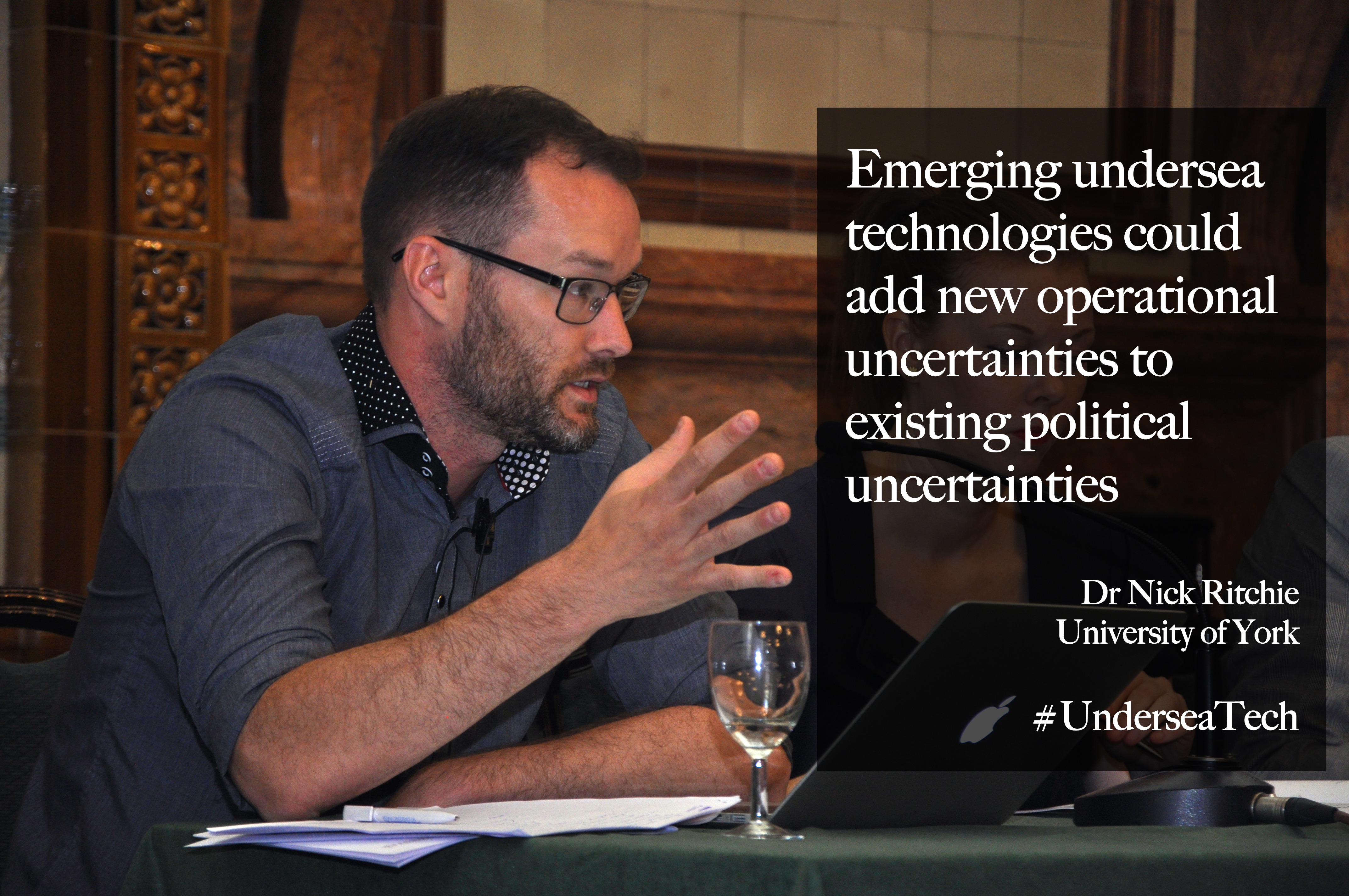
Report: The Impact of Emerging Technologies on the Future of SSBNs
On the 13th September, BASIC, British Pugwash and the University of Leicester hosted a conference at the National Liberal Club, London on emerging undersea technologies and how they could affect the operation of ballistic missile submarines (SSBNs).
To Fix North Korea, Start with Syria
When North Korea launched a nuclear test on 9 September – its fifth so far – it was making a clear statement to the international community of its intentions to continue to pursue full nuclear capability.