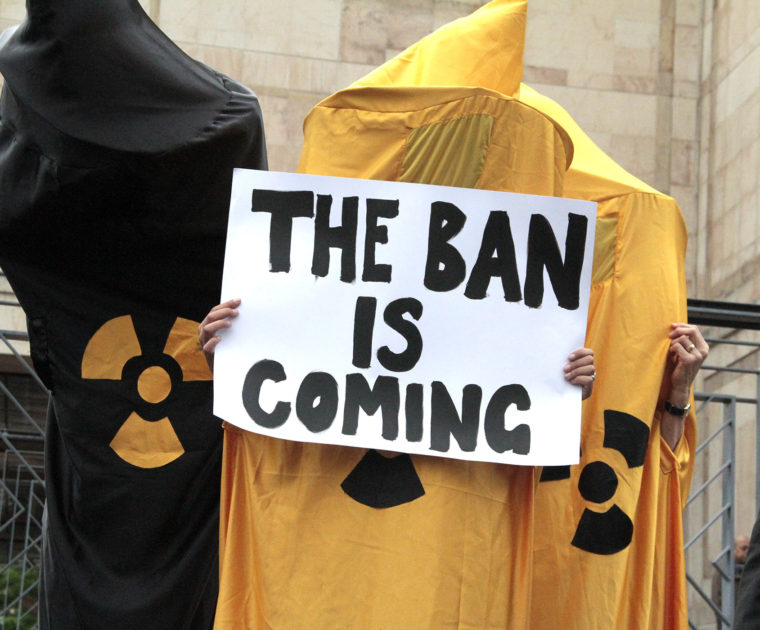
The official draft text of a treaty to ban nuclear weapons is likely to be published in the next two weeks (15-26 May 2017).
Search Results for: press

Should the UK adopt a Restricted First Use policy?
In January 2017, Democratic Senator Ed Markey and Representative Ted Lieu introduced the Restricting First Use of Nuclear Weapons Act 2017 in both houses of Congress. Should the UK follow suit?

Budgeting for Bombs: The Difficulties of Getting Nuclear Modernisation through Congress
On Monday 17th April, US Secretary of Defence James Mattis announced that the United States Nuclear Posture Review had officially begun and will be completed by the end of the year.
United States inconsistency complicates cooperation with Russia on DPRK
Setting the tone for a potential shift in the US policy of multilateral cooperation over North Korea, Joseph Yun, the US Special Representative for North Korea, visited Moscow from April 4-6.
Struggling to Signal: Trump’s Dilemma with Arms Control Diplomacy: 18th April 2017
Some believe the world is a safer place with Trump in the White House.
US and the INF Treaty: Testing NATO: 3rd April 2017
The US response to Russia’s supposed violation of the INF Treaty is a litmus test for the Trump administration’s approach to arms controls and strategic stability. It will give a clear indication of the Administration’s attitude towards relations with Russia, its NATO allies and to arms control more generally.

Zero Days, Millions in damage: A scientist’s review of the RAND report Zero Days, thousands of nights.
A recent RAND report, released just two days after Wikileaks opened its Vault 7 that detailed the CIA’s entire stockpile of vulnerabilities and their suite of cyber tools (also referred as exploits), seeks to establish a protocol and the advantages of state intelligence agencies maintaining classified vulnerability stockpiles.
The First Trends of Trump’s Nuclear Policy Emerge: 27 March 2017
As the Senior Director for Weapons of Mass Destruction and Counter-Proliferation of the National Security Council, Chris Ford plays perhaps the most important role in the US Government for defining the Trump Administration’s upcoming Nuclear Posture Review.