

The beautifully decorated Moses Room in the UK’s House of Lords – complete with a huge portrait of the prophet displaying the tablets of the law – was perhaps an incongruous setting for a grim warning about the threat posed to humankind by nuclear weapons.
But in his opening comments at a conference on nuclear diplomacy jointly organised by BASIC, the Elders and the European Leadership Network (ELN) in the British Parliament, former Colombian President Juan Manuel Santos did not mince his words.
He cautioned that the famous Doomsday Clock – which measures existential threats including nuclear weapons, climate crisis, artificial intelligence, infectious diseases and conflicts − is now 89 seconds to midnight.
That is the closest it’s ever been to global catastrophe in its 78-year history.
And as the risk of Armageddon increases, the former president warned that humanity appears to be indifferent.
“A few years ago, all around the world there would have been demonstrations against the possibility of nuclear war,” he said, “but now – when the risk is so high, it seems nobody cares.”
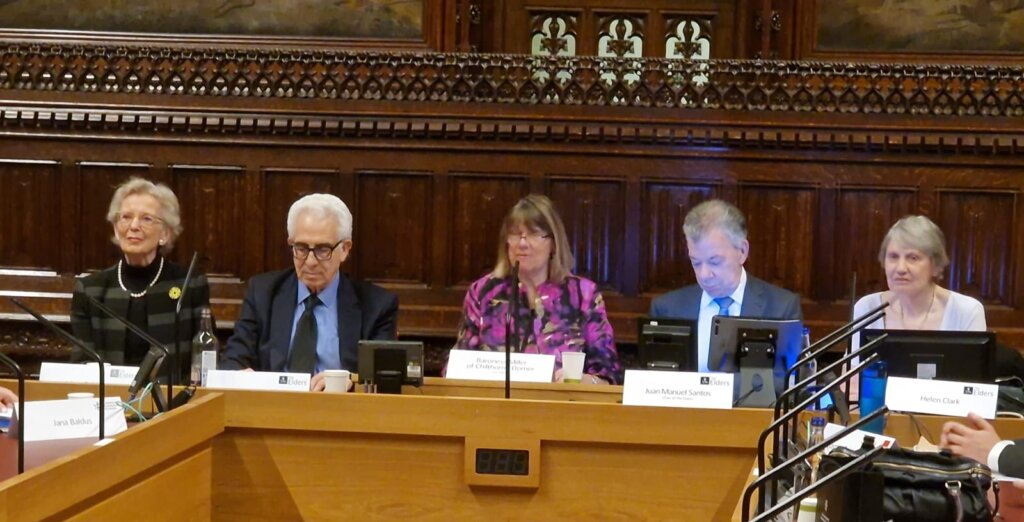 From left to right: Mary Robinson, former President of the Republic of Ireland; Ernesto Zedillo, former President of Mexico; Baroness Miller of Chilthorne Domer; Juan Manuel Santos, former President of Colombia; Helen Clark, former Prime Minister of New Zealand
Former President Santos was one of a panel of four Elders – including former Irish President Mary Robinson, former New Zealand Prime Minister Helen Clark and former Mexican President Ernesto Zedillo – who participated at the House of Lords event. They were joined on the panel by Jana Baldus from the European Leadership Network, and by BASIC’s Executive Director, Sebastian Brixey-Williams.
Former President Zedillo said the level of tension created by nuclear weapons around the world was exacerbated by the equivocation of some states to make a No First Use (NFU) commitment.
He said that such a pledge would reassure non-nuclear states, as would steps to decommission around 2,000 nuclear weapons around the world that are on high operational alert.
Mr Zedillo said that the Elders favoured a minimisation agenda in relation to nuclear weapons, revolving around dialogue to reduce nuclear risks and focusing on four Ds:
- Doctrine – every nuclear state should make an unequivocal NFU declaration
- De-alerting – the priory should be to remove as many weapons as possible form high alert status
- Deployment – there should be a drastic decrease in the quarter of the world’s nuclear weapons that are operationally deployed
- Decreased numbers – there are 12,000 nuclear warheads in the world which should be heavily reduced – with the US, China and Russia each having no more than 500 each.
“[These weapons] could be mothballed without undermining any credible deterrence,” he said. “The more of these weapons that exist, the greater the chance they will be misused.”
“The integration of AI into nuclear command and control systems threatens to undermine human control of nuclear weapons.” (Former Irish President Mary Robinson)
Mr Zedillo invoked former South African President Nelson Mandela’s comments – made in 1998 in relation to nuclear weapons: “Why do they need them anyway?”
In a Q&A session at the end of the meeting Mr Zedillo said it was also imperative for states to abandon the arms race, which was a “vicious cycle that will lead us nowhere”.
Former New Zealand Prime Minister Helen Clark said that as long as these weapons exist, there is a risk of a nuclear accident.
“The world has come perilously close to this in the past,” she said.
She urged the UK to use its influence to negotiate for nuclear disarmament ahead of next year’s negotiations in New York on the future of the Non-Proliferation Treaty (NPT).
“The UK may be a minor nuclear power,” she said, “but it could still be a voice for disarmament. The question is – how is it going to use it?”
Former Irish President Mary Robinson drew attention to another hazard: artificial intelligence.
“The integration of AI into nuclear command and control systems threatens to undermine human control of nuclear weapons,” she warned.
“There is a need for serious dialogue between nuclear states to maintain meaningful human control.”
ELN panellist Jana Baldus for her part initially focussed on next year’s NPT discussions. She warned that expectations for a positive outcome were low and that international arms control had “unravelled completely”.
Ms Baldus said that countries should be prevented from “back sliding” on disarmament commitments and be encouraged to be more transparent in a world where there was no legitimate justification for nuclear weapons.
The ELN was in a good position to bridge-build in relation to achieving a more secure non-proliferation regime because its membership contained such a wide diversity of views, which represented a microcosm of NPT politics.
More must be done, she said, to address the gap between nuclear and non-nuclear states and the global north and the global south.
In the Q&A session towards the end of the meeting, former Defence Secretary Des Browne called on nuclear states to emulate the US and follow the lead of Congress by ensuring a failsafe system is established to prevent the accidental use of nuclear weapons.
Finally, BASIC’s Executive Director Sebastian Brixey-Williams – asked to contribute by former President Zedillo – paid tribute to the think tank’s Emerging Voices Network (EVN) comprising hundreds of up-and-coming nuclear experts around the world.
“These are the people who will probably inherit the responsibility of managing future nuclear threats,” he said.
“The really important thing from our perspective is getting people into a room together… where they can exchange ideas and develop trust with one another.
“We think that nuclear risk reduction can be significantly improved if future government officials know their counterparts on the other side of the table from their earlier participation in the EVN.
“The policy world is so caught up in the short-term cycle that longer term projects like this rarely see the light of day.”
A rare ray of light then, for a discussion that highlighted how humankind’s future alongside nuclear weapons appears to be growing increasingly insecure.