
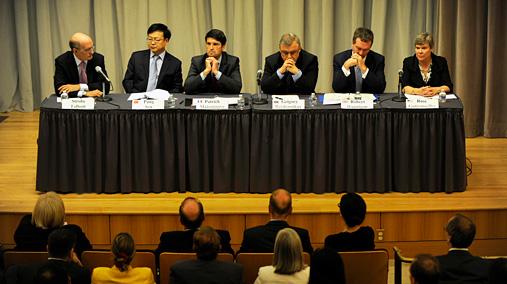
The International Atomic Energy Agency (IAEA) Board of Governors will meet this week, starting today in Vienna, and Iran’s nuclear program will be on the agenda. The May 22ndIAEA report concluded that little has changed since previous assessments of the nuclear program – with Iran continuing to enrich nuclear fuel and Tehran and the Agency at loggerheads over what is necessary to show that all of Iran’s nuclear activities are for peaceful purposes.
Programmes
Russia and the US: realising nuclear disarmament and building trust
According to the most recent estimate by the Federation of American Scientists (FAS), the world's combined stockpile of nuclear warheads stands at more than 17,000. The US and Russia have over 93% of the world's nuclear weapons, with about 1,800 on high alert, ready to unleash their devastating explosive power against each other at short notice.
Getting to Zero: Further Reading
Earlier Detailed Proposals for Nuclear Disarmament
- Report of the Commission on Weapons of Mass Destruction, Weapons of Terror: Freeing the World of Nuclear, Biological and Chemical Arms, (“Blix Report”), June 2006
- Japan Institute of International Affairs, the Hiroshima Peace Institute and the Japanese Government, Report of the Tokyo Forum on Nuclear Non-Proliferation and Disarmament, 1999
- Committee on International Security and Arms Control, National Academy of Sciences,
Getting to Zero Timeline: 2007
December 20, 2007: U.S. Special Representative for Nuclear Nonproliferation, Christopher Ford, spoke at the UK Foreign Office Wilton Park conference about the goal of zero nuclear weapons:
Getting to Zero Timeline: 2008
“Getting to Zero” 2008 Timeline
Getting to Zero Timeline: 2009
December 2009: International Commission on Nuclear Non-proliferation and Disarmament (ICNND) publishes final report: Eliminating Nuclear Weapons: A Practical Agenda for Global Policymakers, Gareth Evans and Yoriko Kawaguchi, Co-Chairs, International Commission on Nuclear Non-Proliferation and Disarmament.
Getting to Zero Timeline: 2010
December 22, 2010: U.S. Senate approves New Strategic Arms Reduction Treaty (New START).
May 28, 2010: Nuclear Non-Proliferation Treaty (NPT) Review Conference 2010 adopts consensus Final Document (PDF), available online via Reaching Critical Will
Getting to Zero timeline: 2011
September 20, 2011: Guinea ratifies the CTBT
July 28-29, 2011: First high-level meeting between the US and North Korea in two years takes place between U.S. Special Representative for North Korea Policy Stephen Bosworth and North Korean First Vice Foreign Minister Kim Gye Gwan in New York. US displayed willingness to restart talks if North Korea demonstrates commitment to a constructive attitude during negotiations.