
This thought piece was written by Dr Nicholas J. Wheeler.
Forty years ago this month, Ronald Reagan and Mikhail Gorbachev came tantalisingly close to agreeing on the elimination of US and Soviet nuclear weapons. Meeting in Reykjavík on 11–12 October 1986, the leaders of the United States and Soviet Union contemplated an agreement that would have abolished the Cold War foundations of nuclear deterrence. Yet far from achieving this historic breakthrough, the summit ended in bitter disappointment.
The fundamental obstacle that blocked success at the summit was Reagan’s Strategic Defense Initiative (SDI)—his ambitious programme to develop a nationwide defence against ballistic nuclear missiles.[1] Matthew Hartwell and Ching Wei Sooi, “Updating Reykjavík’s Lessons for Unlocking Progress, Recognising the Space-Nuclear Nexus”, BASIC, 21 October 2026. Gorbachev insisted that SDI testing remain confined to “laboratories” and if Reagan agreed, then abolition was on the table. The US President refused, wanting the freedom for the United States to test missile defence systems in space during the 10-year period in which both sides would remove their ballistic nuclear weapons. The two leaders parted Reykjavík without the agreement they had both come so close to reaching, their faces showing the frustration they both felt.
The image of Reagan, looking crushed in the back of the car, captured not only his intense disappointment, but also his expectation that Gorbachev would go straight into a press conference and blame Reagan for blocking a historic agreement to ban nuclear arms because of his stubborn attachment to SDI. Gorbachev had agreed with the Soviet Politburo that this was what he would do if negotiations failed. However, when Gorbachev, in his later words “emotional, even shaken”,[2]Mikhail Gorbachev, Memoirs (New York: Doubleday, 1996), p. 419. walked in before the world’s press, a different intention formed within him from the one he had agreed with the Politburo. He appreciated that to condemn Reagan would destroy the trust that had developed between them. In a moment of visionary leadership, he chose instead to show his continuing commitment to his relationship with Reagan when he used language in the press conference that emphasised the cooperative and friendly relationship between the two leaders. Although he called the failure to reach an agreement “sad and disappointing”, Gorbachev added that it “was not an unproductive meeting”[3]Quoted in Philip Taubman, “The Iceland Summit: ‘A Difficult Dialogue’; Gorbachev Angrily Accuses Reagan of Scuttling an Accord at Reykjavik”, The New York Times, 13 October 1986. and he did not disclose any details of their private discussions, nor did he in any way embarrass Reagan for the failure to reach a deal. What is more, when he finally departed Keflavík airport, he told Iceland’s Prime Minister, Steingrímur Hermannsson, that his meeting with Reagan at Reykjavík marked “the beginning of the end of the Cold War”.[4]Quoted in Edmund Morris, Dutch: A Memoir of Ronald Reagan (London: HarperCollins, 2000), p. 599.
As BASIC marks its own 40th anniversary amid renewed nuclear dangers, Reykjavík offers an important lesson: interpersonal trust can transform relations between adversarial state leaders but it cannot eliminate uncertainty about their states’ future intentions. At the same time, interpersonal trust can prevent diplomatic failure turning into a new round of confrontation.
The extraordinary achievement of Reykjavík
Reykjavík was not the beginning of Reagan and Gorbachev’s journey into interpersonal trust. At their first summit in Geneva in November 1985, the two leaders had agreed “that a nuclear war cannot be won and must never be fought”. Crucially, and often overlooked, they also pledged that “they will not seek to achieve military superiority”. These commitments built upon principles established during the détente of the 1970s, notably the 1972 Basic Principles Agreement,[5]United States and Soviet Union, “Basic Principles of Relations Between the United States of America and the Union of Soviet Socialist Republics”, Moscow, 29 May 1972, reproduced in Foreign … Continue reading but their significance lay in the developing interpersonal relationship between Reagan and Gorbachev which gave them new political meaning. Both leaders recalled Geneva as a turning point in their relationship. Gorbachev remembered a “spark of electric mutual trust which ignited between us, like a voltaic arc between two electric poles”.[6]James Hunt and David Reynolds, “Geneva, Reykjavik, Washington, and Moscow 1985–8,” in Kristina Spohr and David Reynolds (eds.), Transcending the Cold War: Summits, Statecraft, and the … Continue reading Reagan similarly recalled leaving Geneva thinking that “after almost five years I’d finally met a Soviet leader I could talk to”.[7]Ronald Reagan, An American Life: The Autobiography (New York: Simon & Schuster, 1990), p. 641. What made this developing trust possible was a growing recognition that neither side could be secure if the other was insecure, and that each contributed through its own actions to the fear and insecurity of the other. This is what Marcus Holmes and I call shared security dilemma sensibility.[8]Marcus Holmes and Nicholas J. Wheeler, Interpersonal Diplomacy: The Making of Atomic Bonds in International Crises (Oxford: Oxford University Press, 2026), p. 43, see also pp. 33-47.
I argue in Trusting Enemies (2018) that Reykjavík marked a decisive further development in their trusting relationship. It was through their face-to-face encounter in Iceland that Reagan and Gorbachev developed what I call “trust as suspension”: a mental state in which leaders cease calculating the risk that the other leader will behave opportunistically towards them and the state they represent.[9]Nicholas J. Wheeler, Trusting Enemies: Interpersonal Relationships in International Conflict (Oxford: Oxford University Press, 2018), pp. 7-9. Reagan and Gorbachev not only recognised their common interest in avoiding nuclear catastrophe as they had at Geneva, the deepening of their trust at Reykjavík enabled them to contemplate acting upon this trust in ways that had previously seemed unimaginable.
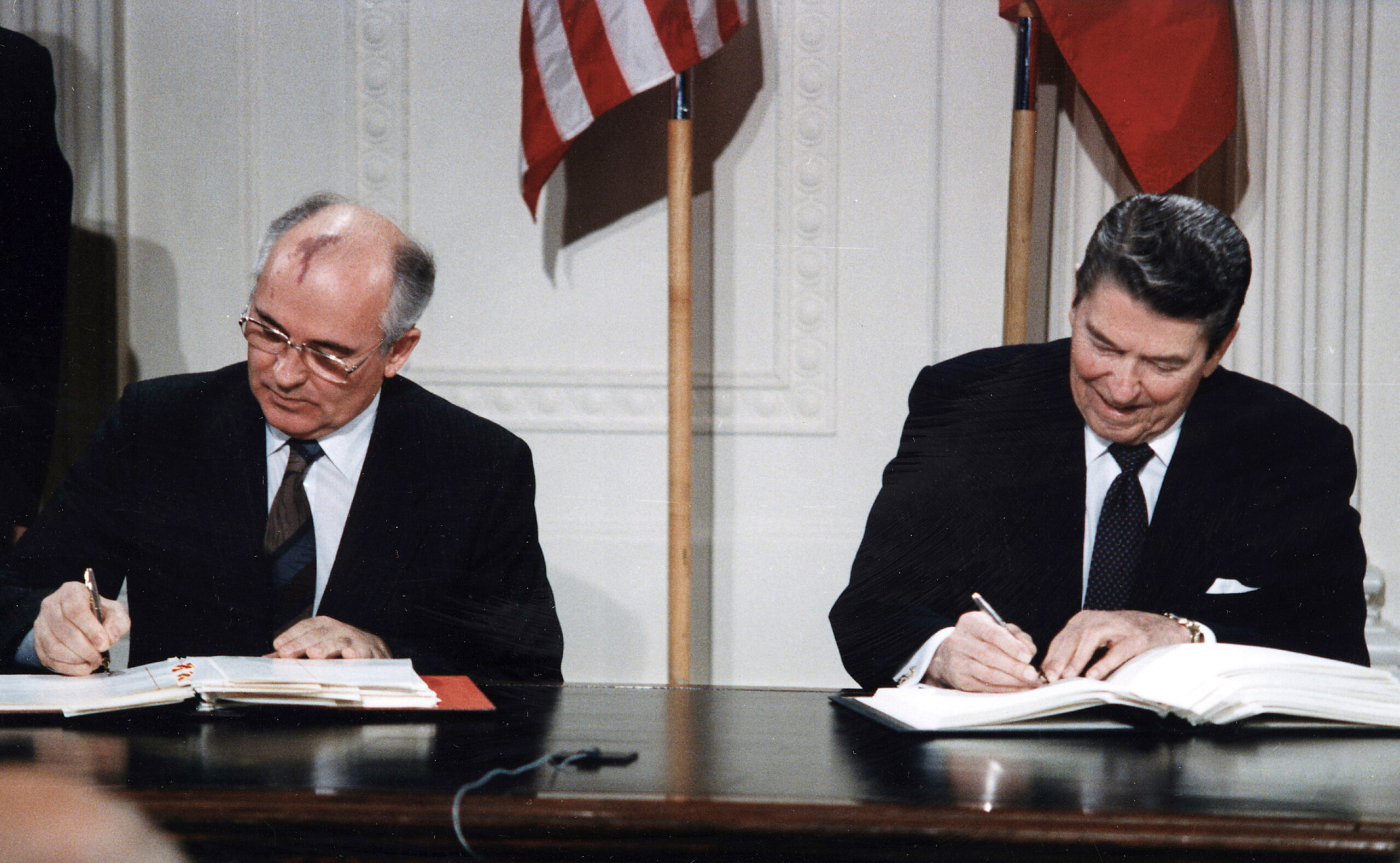
To judge Reykjavík solely by its failure to produce an agreement would miss its enduring achievement. As a result of the trust that strengthened between the two leaders at Reykjavík, Gorbachev took the momentous decision to separate negotiations over intermediate-range nuclear forces from the unresolved dispute over SDI. He subsequently accepted intrusive on-site inspections and the global elimination of intermediate-range missiles, where the Soviet Union had numerical superiority over the United States, paving the way for the Intermediate-Range Nuclear Forces (INF) Treaty signed at the Washington summit in December 1987.
Despite this arms control success, the trust between Reagan and Gorbachev was not sustained at the same level by their successors, and no subsequent US-Soviet/Russia interpersonal dyad has repeated the diplomatic breakthrough achieved by Reagan and Gorbachev. The failure of their successors to sustain the deep trust they achieved and institutionalise it in national security bureaucracies raises a question explored in my recent book with Marcus Holmes, Interpersonal Diplomacy: The Making of Atomic Bonds in International Crises (2026): how can interpersonal trust at the leader-to-leader level be transferred into lasting transformations in relations between adversarial states? This question lies at the heart of BASIC’s work, past, present, and future.
BASIC’s dialogical approach: the lesson for today
BASIC’s commitment to third-party facilitated dialogue rests on the conviction that adversaries need opportunities to understand how their actions are perceived by others. Central to this approach is the cultivation of security dilemma sensibility: recognising that one’s own actions, however defensive they may appear, can generate fear and insecurity in an adversary.[10]The concept of “security dilemma sensibility” is developed in Ken Booth and Nicholas J. Wheeler, The Security Dilemma: Fear, Cooperation and Trust in World Politics (Basingstoke: Palgrave … Continue reading This requires more than listening to the other’s position. It requires a willingness to be open to the possibility that one’s own behaviour is deeply implicated in the fear and insecurity experienced by an adversary.
BASIC’s work in recent years on nuclear crisis escalation and de-escalation in South Asia shows the value of this approach. Adversaries can become trapped in mutually reinforcing assumptions about their own defensive intentions and the inherent bad faith of others. Both sides may believe they are exercising restraint while interpreting the other’s actions as escalating hostility. BASIC’s facilitated Track 2/1.5 dialogues with Indian and Pakistani practitioner and expert communities have invited participants to critically reflect on how far their own understanding of their state’s defensive behaviours are shared by the other side, recognising that others do not see them as they see themselves, and even more ambitiously, developing new narratives that recognise a shared responsibility for the conflict. BASIC’s dialogical approach, in short, guides participants to surface hidden biases opening new possibilities for “cooperative de-escalation”[11]The concept of “co-operative de-escalation” is developed in Eva-Nour Repussard, Nicholas J. Wheeler, and Chiara Cervasio (eds.), “Emerging and Disruptive Technologies in South Asia: Perceptions … Continue reading that may otherwise remain invisible.
Of course, dialogue does not guarantee trust, nor do discussions and shared explorations at the Track 2/1.5 dialogues necessarily translate into concrete progress between adversaries at Track 1. But Reykjavík reminds us that adversarial relationships are not permanently frozen. Less than four years before the summit, Reagan had denounced the Soviet Union as an “evil empire”.[12]Ronald Reagan, “Remarks at the Annual Convention of the National Association of Evangelicals in Orlando, Florida”, Ronald Reagan Presidential Library, 8 March 1983. In November 1983, the superpowers had experienced a dangerous confrontation during NATO’s Able Archer exercise, which Soviet leaders feared might conceal preparations for a surprise nuclear attack.[13]Nate Jones (ed.), “The Soviet Side of the 1983 War Scare”, National Security Archive, 5 November 2018; Taylor Downing, 1983: The World at the Brink (London: Little, Brown, 2018). Yet three years later, Reagan and Gorbachev came close to agreeing on the abolition of nuclear weapons.
The Reagan–Gorbachev story shows that trust can emerge even in conditions of deep distrust. The precondition for this trust was the two leaders developing shared security dilemma sensibility: recognising how their own actions contributed to the fears and insecurity of the other.
Forty years after Reykjavík, this is the challenge at the heart of BASIC’s dialogical approach: creating opportunities for adversaries to see themselves through the eyes of others, test the assumption that the other has hostile intent, and crucially, recognise how their own actions have made others fearful and insecure. The Reagan–Gorbachev relationship was a product of a particular historical moment, but the development of shared security dilemma sensibility is not unique to that relationship. Cultivating this sensibility through dialogue offers a way of escaping deeply ingrained patterns of security competition, and a bridge to the deep trust that flourished between Reagan and Gorbachev in Höfði House in Iceland. That is the enduring lesson of Reykjavík, and the challenge for BASIC’s next forty years.
Nicholas J. Wheeler is a Non-Resident Senior Fellow at BASIC and Professor of International Relations at the University of Birmingham. I am grateful to BASIC’s Executive Director Sebastian Brixey-Williams for comments on an earlier version of this piece.
References
| ↑1 | Matthew Hartwell and Ching Wei Sooi, “Updating Reykjavík’s Lessons for Unlocking Progress, Recognising the Space-Nuclear Nexus”, BASIC, 21 October 2026. |
|---|---|
| ↑2 | Mikhail Gorbachev, Memoirs (New York: Doubleday, 1996), p. 419. |
| ↑3 | Quoted in Philip Taubman, “The Iceland Summit: ‘A Difficult Dialogue’; Gorbachev Angrily Accuses Reagan of Scuttling an Accord at Reykjavik”, The New York Times, 13 October 1986. |
| ↑4 | Quoted in Edmund Morris, Dutch: A Memoir of Ronald Reagan (London: HarperCollins, 2000), p. 599. |
| ↑5 | United States and Soviet Union, “Basic Principles of Relations Between the United States of America and the Union of Soviet Socialist Republics”, Moscow, 29 May 1972, reproduced in Foreign Relations of the United States, 1969–1976, Vol. I, Document 116. |
| ↑6 | James Hunt and David Reynolds, “Geneva, Reykjavik, Washington, and Moscow 1985–8,” in Kristina Spohr and David Reynolds (eds.), Transcending the Cold War: Summits, Statecraft, and the Dissolution of Bipolarity in Europe, 1970–1990 (Oxford: Oxford University Press, 2016), p. 160. |
| ↑7 | Ronald Reagan, An American Life: The Autobiography (New York: Simon & Schuster, 1990), p. 641. |
| ↑8 | Marcus Holmes and Nicholas J. Wheeler, Interpersonal Diplomacy: The Making of Atomic Bonds in International Crises (Oxford: Oxford University Press, 2026), p. 43, see also pp. 33-47. |
| ↑9 | Nicholas J. Wheeler, Trusting Enemies: Interpersonal Relationships in International Conflict (Oxford: Oxford University Press, 2018), pp. 7-9. |
| ↑10 | The concept of “security dilemma sensibility” is developed in Ken Booth and Nicholas J. Wheeler, The Security Dilemma: Fear, Cooperation and Trust in World Politics (Basingstoke: Palgrave Macmillan, 2008), p. 7. |
| ↑11 | The concept of “co-operative de-escalation” is developed in Eva-Nour Repussard, Nicholas J. Wheeler, and Chiara Cervasio (eds.), “Emerging and Disruptive Technologies in South Asia: Perceptions of Risks and Responsibilities in Crisis Management and Prevention”, BASIC, 14 April 2025. It is developed further in BASIC’s report on the dialogues and crisis simulations held with Indian and Pakistani expert and practitioner communities in February 2026. See Nicholas J. Wheeler, Ching Wei Sooi, Mhairi McClafferty, Chiara Cervasio, and Eva-Nour Repussard, “Addressing Future Nuclear Crisis Scenarios in South Asia through a Responsibility-Based Approach”, BASIC, 27 May 2026. |
| ↑12 | Ronald Reagan, “Remarks at the Annual Convention of the National Association of Evangelicals in Orlando, Florida”, Ronald Reagan Presidential Library, 8 March 1983. |
| ↑13 | Nate Jones (ed.), “The Soviet Side of the 1983 War Scare”, National Security Archive, 5 November 2018; Taylor Downing, 1983: The World at the Brink (London: Little, Brown, 2018). |
Leave a Reply