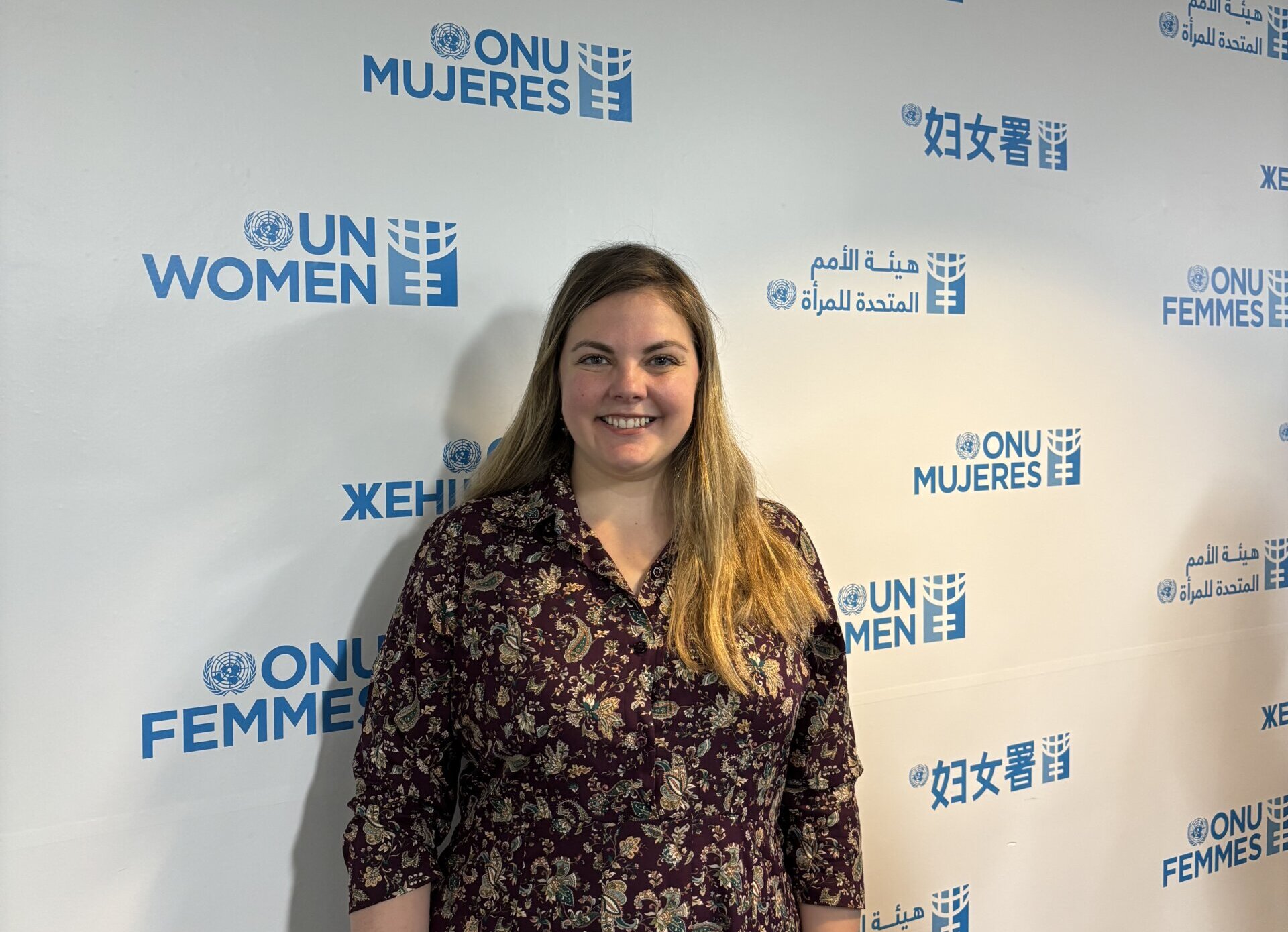
In this article, Dr Lisa Vickers, a Policy Fellow at BASIC’s Risk Reduction Programme, argues that cross-sector alliances between those working on the Women, Peace and Security (WPS) agenda and arms control-disarmament, as well as UN reform, are necessary to address crises affecting women. The views expressed belong solely to the author of the article and do not necessarily reflect their government’s position, any affiliated institutions, or that of BASIC.
This year’s International Women’s Day (IWD) on 8 March took place against the backdrop of complex, interrelated crises that are intensifying worldwide. From conflict and climate change to environmental degradation and digital and hybrid threats, the world is facing interlinked threats that have a disproportionately devastating impact on women and girls.
For example, the effects of government blockades on water access during conflicts are compounded by climate-related water scarcity – and when water is scarce, the lives of women and girls tasked with collecting it from remote filling stations can be severely affected or endangered. The health impacts of nuclear weapon use and testing also disproportionately affect women; and the staggering costs of military build-up have been at the expense of crucial overseas development aid that has traditionally supported women and other marginalised groups.
A well-funded, coordinated backlash against women’s rights has also been gathering pace. These sustained attacks by governments, campaigners, and digital influencers have led to a rollback of women’s rights, including the dilution of existing protections and the introduction of repressive laws. Led by US President Donald Trump, funding for the entire global aid architecture – as well as support for women and girls specifically – has also been drastically cut. Urgent action – including UN reform – is needed to give women and girls the necessary support to thrive.
The UN At A Crossroads
Traditionally, the UN has brought together multilateral stakeholders to cooperate on advancing women’s rights and opportunities, as well as tackling the crises that affect them. Just last year, women’s organisations celebrated the 25th anniversary of UN Security Council Resolution (UNSCR) 1325, which acknowledges the gendered impacts of wars and armed conflicts upon women and girls. Subsequent UN resolutions have outlined the urgency of including women in disarmament initiatives, including UN General Assembly resolutions 65/69 (2010) and 67/48 (2012), which call for the equal participation of women in disarmament, arms control, and non-proliferation decision-making.
But the UN faces serious challenges which severely curtail its ability to support women – calling for urgent reform and new cross-sector collaborations. Some of these challenges are new – Trump’s withdrawal of the US from various UN bodies and the apparent attempts of his so-called “Board of Peace” to circumvent UN institutions, for example. The UN is also facing “imminent financial collapse” – potentially running out of money by July 2026. Other critiques of the UN are long-standing, such as the UN Security Council being unrepresentative and ineffective due to permanent members’ veto powers. Trust in the UN’s efficacy and ability to operate in an increasingly complex and divided world continues to erode.
The Shape of Reform
So, what can be done? Firstly, the UN must take bold steps towards renewal and reform – albeit under constrained and highly volatile circumstances. Secondly, reform must place the rights and needs of women and girls front and centre. Thirdly, there needs to be far more collaboration between those working on the Women, Peace and Security (WPS) agenda – comprising prevention, protection, participation, and relief and recovery pillars – and those focused on arms control-disarmament. This includes forging closer alliances between sectors that rarely overlap: security domains need to be “de-siloed”, enabling robust discussions among experts from different security backgrounds (e.g. nuclear weapons, cyber warfare, and digital threats). Finding comprehensive, sustainable solutions to security threats hinges on diverse experts working in tandem.
Researchers Leading the Way
With the UN under threat, researchers are taking the initiative to reduce interconnected risks. For the past three years, a de-siloing approach has guided BASIC’s Rethinking European Security project: we have held five track 1.5 regional workshops across Europe, bringing together more than 100 experts and government officials from 30 countries to discuss a future European security architecture – including examining how energy and climate outlooks shape security. This project has highlighted the importance of experts and leaders across different security domains conversing with one another to reach sustainable solutions.
The need to de-silo within a UN context has been long-standing, particularly between arms control-disarmament and WPS communities. This was made apparent at the annual Open Debate on WPS in October 2025 at the UN Security Council. The side events around the open debate featured experts in WPS, including the architects of UNSCR 1325. The event “The Ghosts of 1325: Past, Present, Future”, for example, focused on how the WPS agenda has made progress but has also been sidelined in global geopolitics. These high-level discussions were grounded in reflections from decades of women’s activism and expert applications, as well as critiques, of the WPS agenda’s four pillars.
This open debate coincided with the proceedings of the UN First Committee on Disarmament. It was on the sidelines of this gathering that the event “Empowering change: The role of Women in WMD non-proliferation and disarmament” took place. It presented a unique opportunity for the WPS and arms control-disarmament communities to strategise together. Speakers discussed the barriers women face to working in the arms control-disarmament field, and the lack of funding for gender mainstreaming.
This event was a welcome step in facilitating discussions on subjects pertaining to arms control-disarmament and WPS. However, the overlap between those attending the open debate and the First Committee seemed limited, with those from the latter category overrepresented. It is therefore no surprise that the WPS pillar of participation was highlighted without equal consideration given to the other three pillars (prevention, protection, relief and recovery). As a result, the event missed an opportunity to engage in an in-depth discussion around all pillars.
Efforts over recent years have been made to connect WPS and arms control-disarmament groups. Organisations like the Gender and Disarmament Hub at the UN Institute for Disarmament Research (UNIDIR) and Reaching Critical Will, and initiatives such as the Vienna Center for Disarmament and Non-Proliferation’s (VCDNP) Young Women and Next Generation Initiative, as well as Women in Nuclear, have sought to attract more women into the arms control-disarmament sector. Yet further opportunities for dialogue among experts in WPS and arms control-disarmament are needed as a dominant agenda item.
Strengthening Justice for Women and Girls
International Women’s Day (IWD) on 8 March and the Commission on the Status of Women (CSW) from 9-19 March are spaces to concentrate minds and drive reform. The priority theme for CSW this year is:
Ensuring and strengthening access to justice for all women and girls, including by promoting inclusive and equitable legal systems, eliminating discriminatory laws, policies, and practices, and addressing structural barriers.
This theme presents scope and opportunities for WPS advocates to work across security domains – and in partnership with the public and private sector – to ensure that systems, laws, policies, and practices are equitable and inclusive. Costa Rica’s Ambassador Maritza Chan Valverde will serve on the Bureau for this year’s CSW. As the first woman to chair the UN First Committee on Disarmament and a strong proponent of women’s inclusion in disarmament and security issues, her participation could be instrumental in focusing discussions on intersections between arms control-disarmament and WPS agendas.
CSW will conclude just weeks before the 2026 Review Conference (RevCon) of the Parties to the Treaty on the Non-Proliferation of Nuclear Weapons (NPT) at UN headquarters. If these two events more closely coincided, there could have been space to bring leading experts from both communities together for dialogue. If the UN is to be reformed, creating spaces for leading experts to meaningfully engage one another outside of their respective silos is imperative.
The Path Forward
Overall, we need far bolder approaches to dialogue on intersecting crises. This involves going beyond UN side events to make use of the UN as a staging ground for robust, in-depth discussions. And, with the spotlight now on UN reform, these plans must make de-siloing security communities a core ambition.
At my initiative, the Centre for Geopolitics, University of Cambridge is aiming to establish a new Women, Governance and Security (WGS) Programme. This programme aims to shift policy to be more inclusive and responsive to diverse and often overlooked populations, particularly women. It will involve breaking down silos between traditional and non-traditional security domains, building a sustained community of research and practice, and highlighting how international security, global governance, and decision-making affect women.
This programme has already hosted a series of events, including a Geopolitics and WPS Roundtable in July 2025 (findings and policy recommendations are here). Establishing such a programme is a crucial step to further women’s representation and decision-making in an increasingly insecure world.
Please join BASIC at RevCon and CSW to discuss these issues further and look out for forthcoming events organised by the new Cambridge programme.
Dr Lisa Vickers is a Policy Fellow at BASIC, where she works in the Risk Reduction programme. Her research interests are in gendered and human security approaches to risk reduction and disarmament.
In addition to her role at BASIC, Lisa is a Research Assistant at the Centre for Geopolitics at the University of Cambridge, and is aiming to launch the Women, Governance and Security Programme at the Centre for Geopolitics. She can be contacted via email at [email protected]