
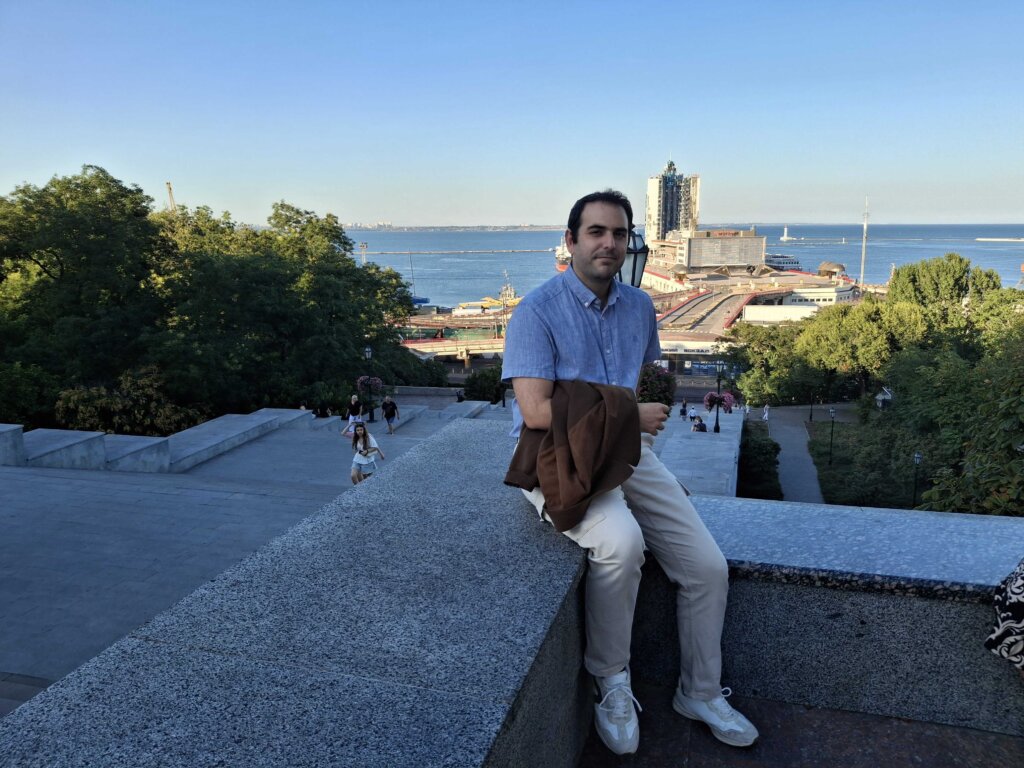
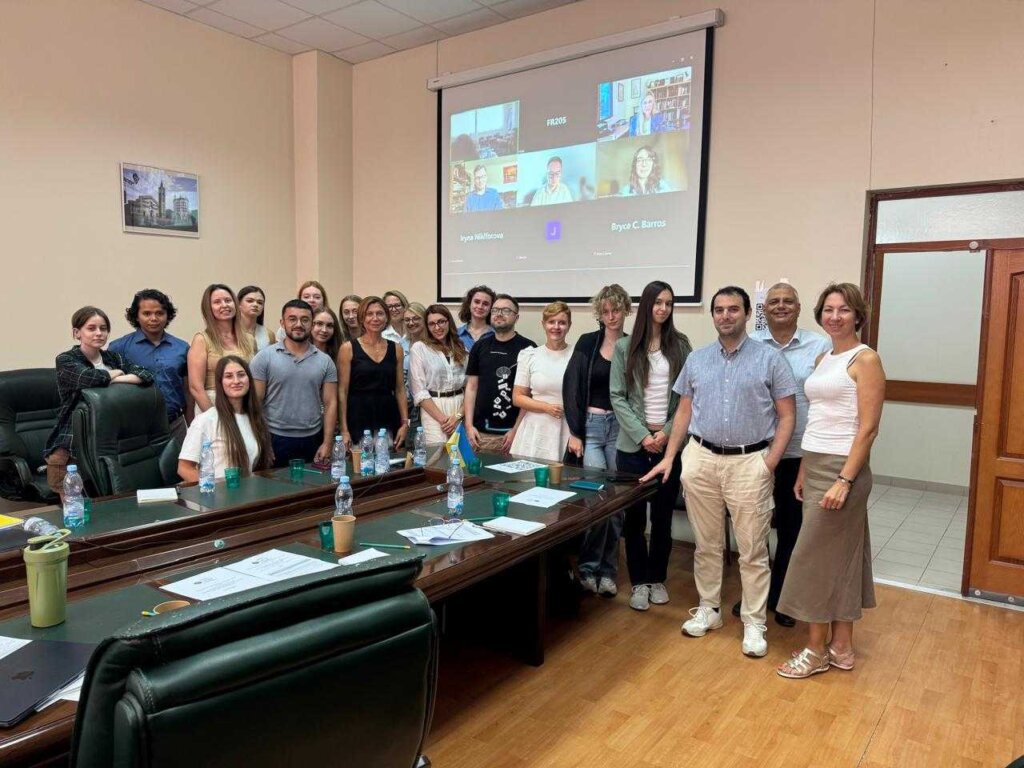
Senior Policy Fellow and Non-Proliferation and Disarmament Programme Manager Dr Manuel Herrera recently travelled to Odessa, Ukraine, to serve as a speaker at the 2025 OdCNP Summer School. During the event, he delivered two presentations focused on the Nuclear Non-Proliferation Treaty (NPT) and the IAEA safeguards system. Manuel reflects on his travels here:
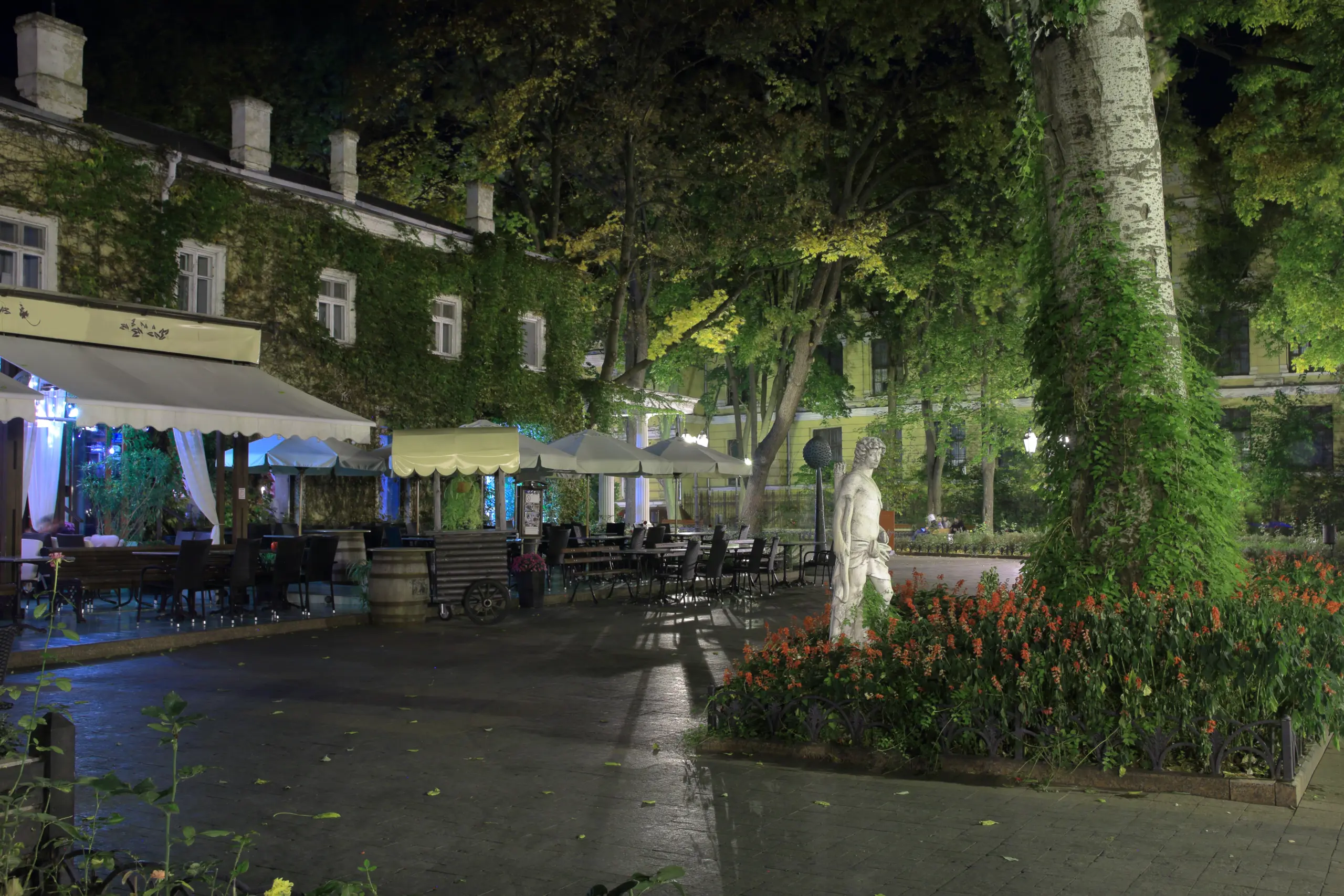
Beyond the academic programme, I encountered a city that, at first glance, appeared calm and vibrant, despite the shadow of war. Odessa, perched on the Black Sea, literally seemed to keep calm and carry on. Locals went about their routines as normal despite the constant awareness of a potential Russian attack. In fact, just days after I left the city, Russia launched a surprise missile strike on residential areas. Yet, this looming threat has not deterred Odessans from embracing life with a mix of defiance and exuberance.
The historic boulevards of Odessa’s UNESCO-listed city centre were teeming with life: bustling fashion boutiques, lively cafés, and restaurants packed to capacity. Tables overflowed with wine, beer, and other Slavic brews, which quickly made their way down the throats of Ukrainians eager to set aside the weight of war — if only briefly — and channel their stress into joy and celebration. In short, life continues, even under extraordinary circumstances.
From the perspective of Ukrainian policy experts, however, the outlook on the war remains a mix of resignation and caution. Resignation stems from a shared belief that the war cannot be won militarily; retaking occupied territories by force now seems impossible. Any future ceasefire agreement, they argue, would almost certainly acknowledge Moscow’s de facto control over occupied regions, even if not de jure. At the same time, there is a strong sense of prevention: Kyiv is actively negotiating with European capitals and Washington for more robust security guarantees than those outlined in the 1994 Budapest Memorandum.
These guarantees, experts suggest, would need to be enshrined in a legally binding document — either a treaty, a convention, or accelerated EU accession under Article 42.7 of the Lisbon Treaty, which provides for mutual defence. The envisioned arrangement includes a multinational security force with British, French, German, Polish, and Italian troops permanently stationed in Ukraine, logistically supported by the United States. Should such a commitment be formalised — or even politically guaranteed — Ukrainian officials believe a ceasefire agreement could be signed immediately. But given the Kremlin’s oft-stated resistance to foreign troops in Ukraine, this outcome is by no means a foregone conclusion.
Still, as Ukrainian colleagues emphasised, the obstacle lies in Moscow. Would Russia accept such a scenario? Their immediate answer: no. As long as the Kremlin believes it can topple Kyiv or achieve full military control of Ukraine, a ceasefire remains unlikely. Unless Russian leaders come to terms with the infeasibility of outright victory, the conflict — even at a lower intensity — is destined to drag on.
Travelling to Ukraine today remains a test of endurance. The journey requires a flight to Moldova, a long bus ride, several hours at the border, and yet another drive to Odessa. But for those who make it, the effort is rewarded with a powerful image: a courageous and unyielding people, determined to resist an invader while embracing life with resilience, serenity, and remarkable normalcy.