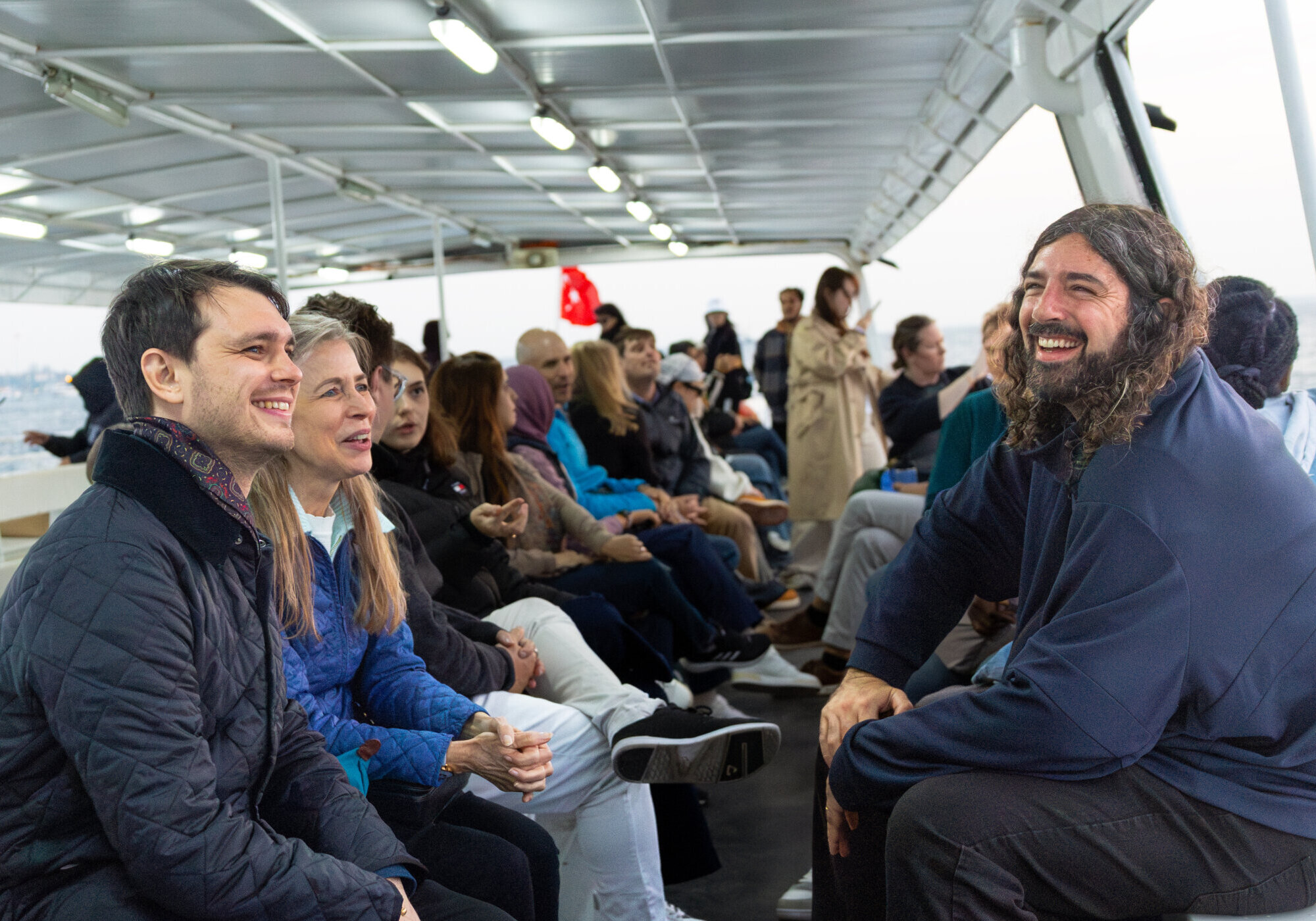
In collaboration with the Stanley Center for Peace and Security, BASIC recently hosted an oral history workshop to launch the “Adventures in Risk Reduction: Oral History Project”. Below, workshop participant Bruno Martini shares his experience of the event and reflects on the particular suitability of oral history methodology for nuclear risk reduction. The views expressed in the article are those of the author and do not necessarily reflect those of BASIC.
The Stanley Center for Peace and Security and The British American Security Information Council (BASIC) convened a group of early-career professionals in Istanbul, Türkiye, between 3-7 November 2025, for an intensive workshop on oral history and nuclear risk reduction. I arrived with intellectual curiosity and some practical expectations about how this method could enhance my own work. I saw the training as a chance to add a new qualitative tool to my methodological toolkit and to explore how memory, narrative, and personal testimony shape global security governance
My colleague Chiara Fargnoli has already captured, in her excellent article, the atmosphere of collaboration that defined our five days together: the multinational character of the cohort, the generosity of the instructors, and the sense that oral history can deepen our understanding of nuclear diplomacy in ways conventional policy analysis cannot fully encompass. As Fargnoli observed, “in a field characterised by strategic ambiguity, political sensitivity, and secrecy, much of the wisdom held by practitioners remains unwritten, inaccessible, or sometimes unclear”. Building on her reflections, I want to expand the discussion through my own experience and emphasise how this method intersects with strategic analysis, diplomacy, and multilateral nuclear governance.
A Method Rooted in Empathy and Rigour
The workshop featured academic sessions taught by Shanna Farrell from the Oral History Center, University of California, Berkeley, and individual guidance provided by Jennie Gromoll, an oral history practitioner with a long career at the US Department of State Bureau of International Security and Nonproliferation. We observed a live demonstration of an oral history interview and conducted our own recorded practice in pairs, including design, pre-interview, and transcription.
What struck me most was the balance between ethical discipline and investigative precision needed to capture unique perspectives from relevant actors. Oral history is often mistakenly understood as an informal conversation or a form of journalism. Unlike journalism, which prioritises immediacy and public-facing reporting, oral history privileges depth, contextual interpretation, and the long-term preservation of personal testimony – carefully reviewed and authorised by the interviewee, who, in this methodology, is a co-participant and referred to as the narrator, prior to publication. In reality, oral history demands carefully designed research questions; an ethical framework aligned with human-subject research principles; respect for the agency and boundaries of the interviewee; methodological transparency; and an understanding of how memory interacts with political environments. This duality – empathy with rigour – is exactly what nuclear risk reduction requires.
An Entirely Immersive Learning Environment
From the formal sessions, which ran from 9:00 to around 17:00, to the shared meals that stretched from early morning into the late evening, the schedule created an immersive atmosphere that felt close to fieldwork. We discussed interviewing techniques, debated case studies, refined our research projects, and exchanged perspectives with colleagues from four continents, whether over meals or during our walks between the hotel and Soho House, which hosted the workshop.
This intensity built not only technical skills, but trusting networks, a fundamental asset when your aim is to ask senior policymakers to recount decisions made under immense political pressure. It also created the kind of environment where genuine friendships could grow, bringing a human dimension to a field that, at its core, is about empathy and the preservation of life.
Each participant was tasked with designing an oral history project focusing on an individual who played a meaningful role in global nuclear risk reduction. The result will be a publicly accessible oral and written archive of personal narratives preserved for future generations and available to researchers around the world seeking to understand how these actors shaped efforts to reduce nuclear risk.
Why Oral History Matters for the Future of Nuclear Policy
The nuclear policy field frequently relies on quantitative models, strategic theory, and governmental documentation. Listening to the instructors and to my colleagues made clear how much this approach, although essential, still leaves out. The Istanbul training showed that oral history can illuminate what rarely appears in official records: the tacit knowledge accumulated over decades of practice, the informal diplomacy that unfolds on the margins of negotiations, the tension between political directives and personal judgment, and the cultural and institutional constraints that shape decision-making. It also captures the lessons learned that people carry with them, but that never make it into written reports.
In a moment when nuclear risks are driven not only by arsenals but by miscommunication, mistrust, emerging technologies, and strategic opacity, oral history offers a way to humanise and contextualise the choices made by those shaping global security.
Cross-National Perspectives on a Fragmented World
One of the greatest strengths of this cohort lies in the diversity of perspectives represented within it. Coming from different regions, political cultures, and professional traditions, participants brought distinct experiences with international security, diplomacy, and nuclear governance. This plurality created a learning environment in which no single narrative dominated and where national assumptions could be questioned, contrasted, and enriched through genuine exchange.
Occupying this multivocal space made oral history especially powerful. It allowed us to approach sensitive strategic issues without the constraints of a single alliance framework, to listen across cultural and political boundaries, and to interpret personal testimonies with a heightened awareness of how context shapes decision-making. In this sense, the collective diversity of the group itself became an analytical asset, one that fostered a more nuanced, plural, and less polarised understanding of nuclear risk.
Looking Ahead
In 2026, we will conduct our interviews in person, accompanied by representatives from the Stanley Center or BASIC. The final materials will be published online and preserved in institutional archives. Later, the cohort will reunite for a capstone event to present our findings and, hopefully, to strengthen a cross-regional network of professionals dedicated to reducing risks imposed by weapons of mass destruction.
The Istanbul workshop “Adventures in Risk Reduction: Oral History Project” was only the beginning. Oral history has already proven to be more than a method: it is a diplomatic instrument, an analytical lens, and a bridge between narratives that rarely meet. And in a moment of intensifying geopolitical fragmentation, bridges may be our most valuable strategic asset.
Bruno Martini is a Ph.D. Candidate in Aerospace Sciences at the Brazilian Air Force University (UNIFA), a Researcher at UNIFA Simulations and Prospective Scenarios Laboratory (LSC), and a Fellow at the United States Space Force (USSF).