
On Thursday and Friday, the UN Open-Ended Working Group (OEWG) on nuclear disarmament meets for the third time in Geneva. The OEWG was established in December 2012, under UNGA Resolution A/RES/67/56, to develop proposals for innovative and measured steps to take forward multilateral nuclear disarmament for the achievement and maintenance of a world free of nuclear weapons.
Nuclear Arms Control and Disarmament
Friends, foes, & the unstable future: the impact of nukes on security relations in South Asia
The volatile security environment of South Asia has traditionally been dominated by on-going tensions and conflicts between Pakistan and India, who have held a tense and inimical relationship since their emergence as separate nations in 1947. The threat perception arising out of the historical tension and enduring rivalry between both countries has put them in a security dilemma in which the risk of nuclear conflict simply cannot be ruled out.
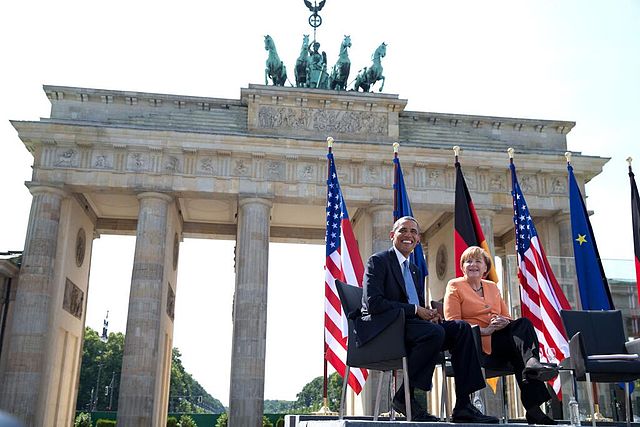
What comes next for U.S. nuclear weapons policy?
This Wednesday, President Obama is slated to give his next big foreign policy speech at the historically significant Brandenburg Gate in Berlin. It was at this Gate – an enduring symbol of both the division and subsequent unity of East and West Berlin – that Ronald Reagan urged then-General Secretary of the Soviet Union, Mikhail Gorbachev, to “tear down this wall” in 1987, and President Clinton spoke of a free and unified Berlin in 1994, following the end of the Cold War.
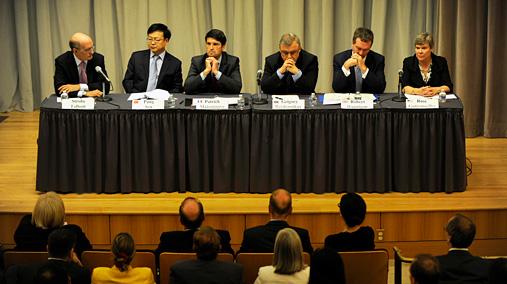
They’re not the P5, so stop calling it the P5 process!
“The limits of my language means the limits of my world.”– Ludwig Wittgenstein
The language we use affects the world as we interpret it. While many are all-too familiar with the “sticks and stones” of the nuclear world, less attention has been paid to the terminology around disarmament and nonproliferation.
PAIS/BASIC Nuclear Weapons Conference: The Future of Nuclear Weapons – Between Disarmament and Proliferation
BASIC & the Department of Politics and International Studies (PAIS) held a one-day conference on nuclear non-proliferation and disarmament. The conference brought together key thinkers from academia, policy-making, and non-governmental organsations to discuss the future of British nuclear weapons policy, and the prospects for non-proliferation and disarmament in the Middle East.
Getting to Zero: Further Reading
Earlier Detailed Proposals for Nuclear Disarmament
- Report of the Commission on Weapons of Mass Destruction, Weapons of Terror: Freeing the World of Nuclear, Biological and Chemical Arms, (“Blix Report”), June 2006
- Japan Institute of International Affairs, the Hiroshima Peace Institute and the Japanese Government, Report of the Tokyo Forum on Nuclear Non-Proliferation and Disarmament, 1999
- Committee on International Security and Arms Control, National Academy of Sciences,
Getting to Zero Timeline: 2007
December 20, 2007: U.S. Special Representative for Nuclear Nonproliferation, Christopher Ford, spoke at the UK Foreign Office Wilton Park conference about the goal of zero nuclear weapons:
Getting to Zero Timeline: 2008
“Getting to Zero” 2008 Timeline