
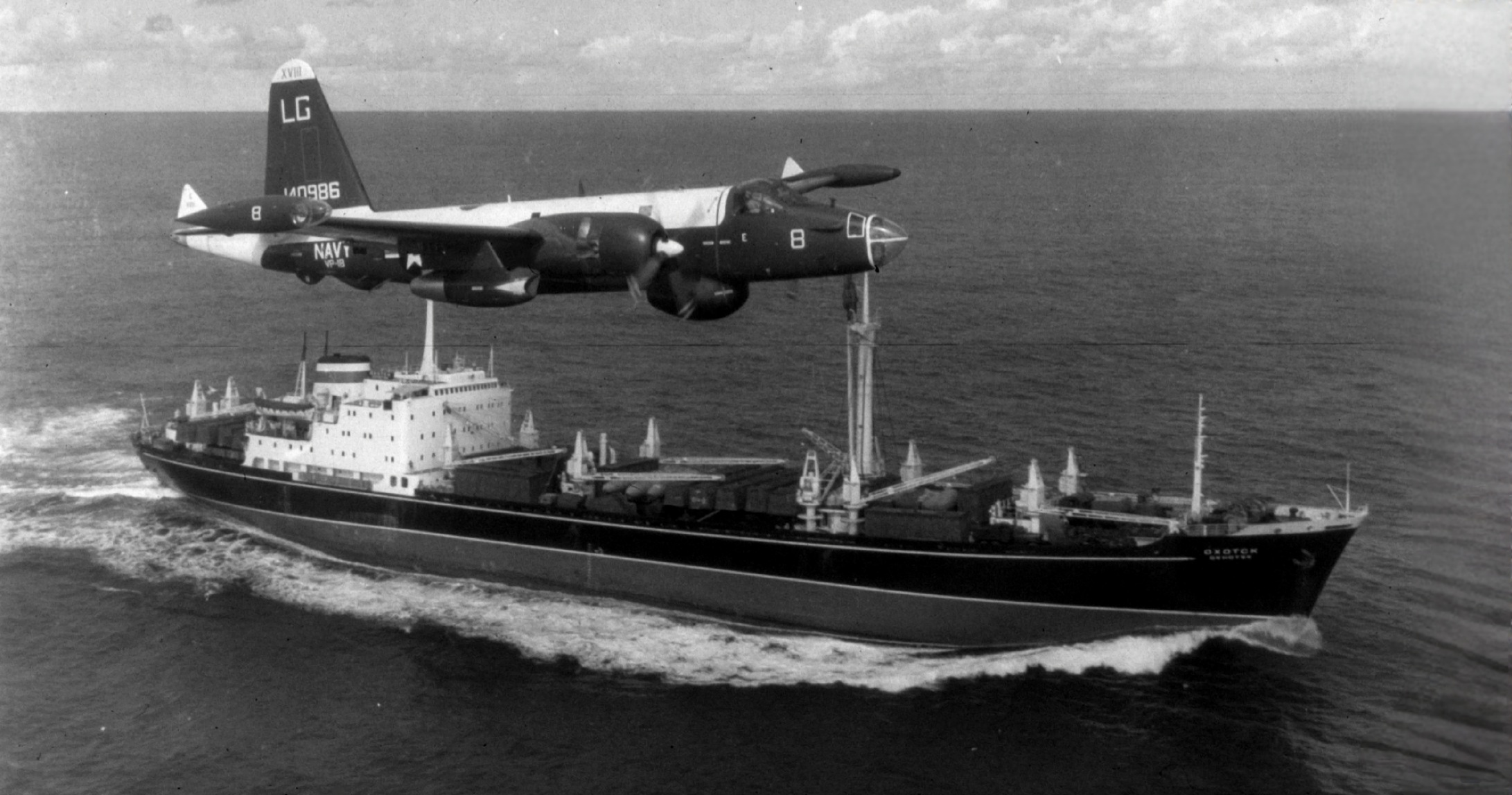
The most dangerous day of the Cuban Missile Crisis has become known as “Black Saturday”: the day the world came closest to nuclear annihilation. On Saturday 27 October 1962, a US U-2 reconnaissance aircraft was shot down over Cuba, killing its pilot, Major Rudolf Anderson, as President John F. Kennedy and Soviet leader Nikita Khrushchev struggled to prevent their confrontation from spiralling into a nuclear war. Kennedy described the shooting down of the U-2 as “an escalation by them,” to which his Secretary of Defense, Robert McNamara replied, “Yes, exactly”. However, when the moment of decision as to whether to retaliate came, Kennedy chose not to—fearing that to do otherwise would set the superpowers on a path of deadly escalation.
Kennedy’s decision to pursue restraint was the one that Khrushchev had implored him to take the previous day in a remarkable letter. Describing their confrontation as a “knot of war”, the Soviet leader warned his US counterpart that “we and you ought not now to pull on the ends of the rope in which you have tied the knot of war, because the more the two of us pull, the tighter that knot will be tied… Consequently, if there is no intention to tighten that knot and thereby to doom the world to the catastrophe of thermonuclear war, then let us not only relax the forces pulling on the ends of the rope, let us take measures to untie that knot. We are ready for this”. Khrushchev’s message revealed his fear that he and Kennedy were losing control of the crisis—one that Kennedy shared himself—but his letter invited his US counterpart to cooperate with him in de-escalating it.
The most important lesson of the Cuban Missile Crisis is that both leaders, recognising their shared vulnerability, turned the crisis from what Thomas Schelling calls a “competition in risk taking” into what has been called “co-operative de-escalation”.
Cuba: learning to de-escalate together
As one of the authors and Marcus Holmes argue, the shared fear generated by the crisis helped Kennedy and Khrushchev develop “shared security dilemma sensibility”: the capacity to recognise that an adversary’s behaviour may be driven by fear and insecurity, including a recognition of how this fear has been generated by one’s own actions. Through their exchange of letters during the crisis, the two leaders increasingly recognised their shared vulnerability and responsibility for avoiding nuclear war. This created the conditions for the development of interpersonal trust which played a critical role in Khrushchev accepting the public commitment by the United States not to invade Cuba and Kennedy’s secret promise to remove the US Jupiter missiles from Turkey. Kennedy appreciated the importance of nurturing this new-found bond with his Soviet counterpart as was evidenced in perhaps the most important speech he gave in his presidency, his June 1963 Commencement Address at American University. Rather than trumpeting a US victory, he urged Americans to reconsider their attitudes towards the Soviet Union, emphasising both their shared humanity and shared fate in avoiding nuclear destruction. “It is an ironic but accurate fact” he said, “that the two strongest powers are the two in the most danger of devastation. All we have built, all we have worked for, would be destroyed in the first 24 hours”. Khrushchev also recognised the need for the two superpowers to build on their common interest in avoiding nuclear war: the establishment later that year of a direct Washington-Moscow communications link—the fabled “hotline”—and the signing of the Partial Test Ban Treaty (PTBT) reflected this recognition of shared responsibility.
India and Pakistan: competing lessons from May 2025
The contrast between the “cooperative de-escalation” of the Cuban Missile Crisis and escalation dynamics in other nuclear dyads is a troubling one. Consider the May 2025 India-Pakistan crisis. Both governments claim military success. India presents Operation Sindoor as demonstrating its capacity to impose military costs on Pakistan while controlling escalation beneath the nuclear threshold. Pakistan’s counter-narrative claims its military response reinforced deterrence and denied India its objective of prosecuting conventional war under the nuclear threshold.
If Kennedy and Khrushchev believed that the Cuban Missile Crisis had been a “win-win” because they cooperated to avoid nuclear ruin, India and Pakistan have drawn very different lessons from the de-escalation of the May 2025 crisis. Moreover, as Dr Rabia Akhtar’s work on narrative stability highlights, these divergent lessons risk a situation where the next crisis starts from a higher baseline of escalation. There is evidence that India believes the crisis ended because it established a position of what Herman Kahn famously called “escalation dominance”. Not surprisingly, Pakistan rejects this interpretation, claiming that, as the crisis escalated, India reached out to the United States to intervene to broker a deal—India denies this. The worry is that if Indian decision-makers believe the crisis ended through India’s ability in the words of the former Chief of the Defence Staff, General Anil Chauhan to “dominate every ladder of escalation”, then this might embolden New Delhi in a future crisis to press harder. Equally concerning, if Pakistani decision-makers believe this is the Indian perception, they will be determined in a crisis to disabuse Indians of this belief.
NATO and Russia: the danger of learning the wrong lessons
Earlier this month, President Vladimir Putin warned in the context of what he claimed were NATO threats against Kaliningrad that Russia would use “all arms at the disposal of our country” if Russia was attacked. There is no evidence that NATO is preparing such an attack. But the confrontation raises a wider question about what Russia and NATO have learned from their nuclear signalling during the war in Ukraine.
Russia’s nuclear capabilities have undoubtedly limited NATO’s conventional military support for Ukraine, though Putin’s nuclear threats have not limited this support as much as he had assumed it would, with NATO’s involvement deepening as the conflict has progressed. At the same time, NATO’s nuclear deterrent has deterred Russia from attacking NATO’s supply lines into Ukraine. The worry is that both sides, as in the India-Pakistan dyad, may be exaggerating or misjudging their ability to control escalation. NATO’s determination not to be intimidated by Russian nuclear threats in its support for Ukraine raises this question: At what point Putin might decide that he can no longer have his bluff called by NATO and seek to gamble on the Alliance breaking under the strain of a major escalation?
Learning the right lessons
Kennedy and Khrushchev recognised at the most dangerous moment of the Cuban Missile Crisis that to escape nuclear catastrophe, they had to work together rather than resort to nuclear brinkmanship. Achieving this cooperative outcome without coming as close to the risks of nuclear conflict as Kennedy and Khrushchev did is the challenge confronting nuclear adversaries today, whether in South Asia, Europe or the Asia-Pacific. This is the enduring lesson of “Black Saturday”.
Nicholas J. Wheeler is a Non-Resident Senior Fellow at BASIC and Professor of International Relations, Department of Political Science and International Studies, University of Birmingham.
Syed Ali Zia Jaffery is Deputy Director, Center for Security, Strategy and Policy Research (CSSPR), University of Lahore.