
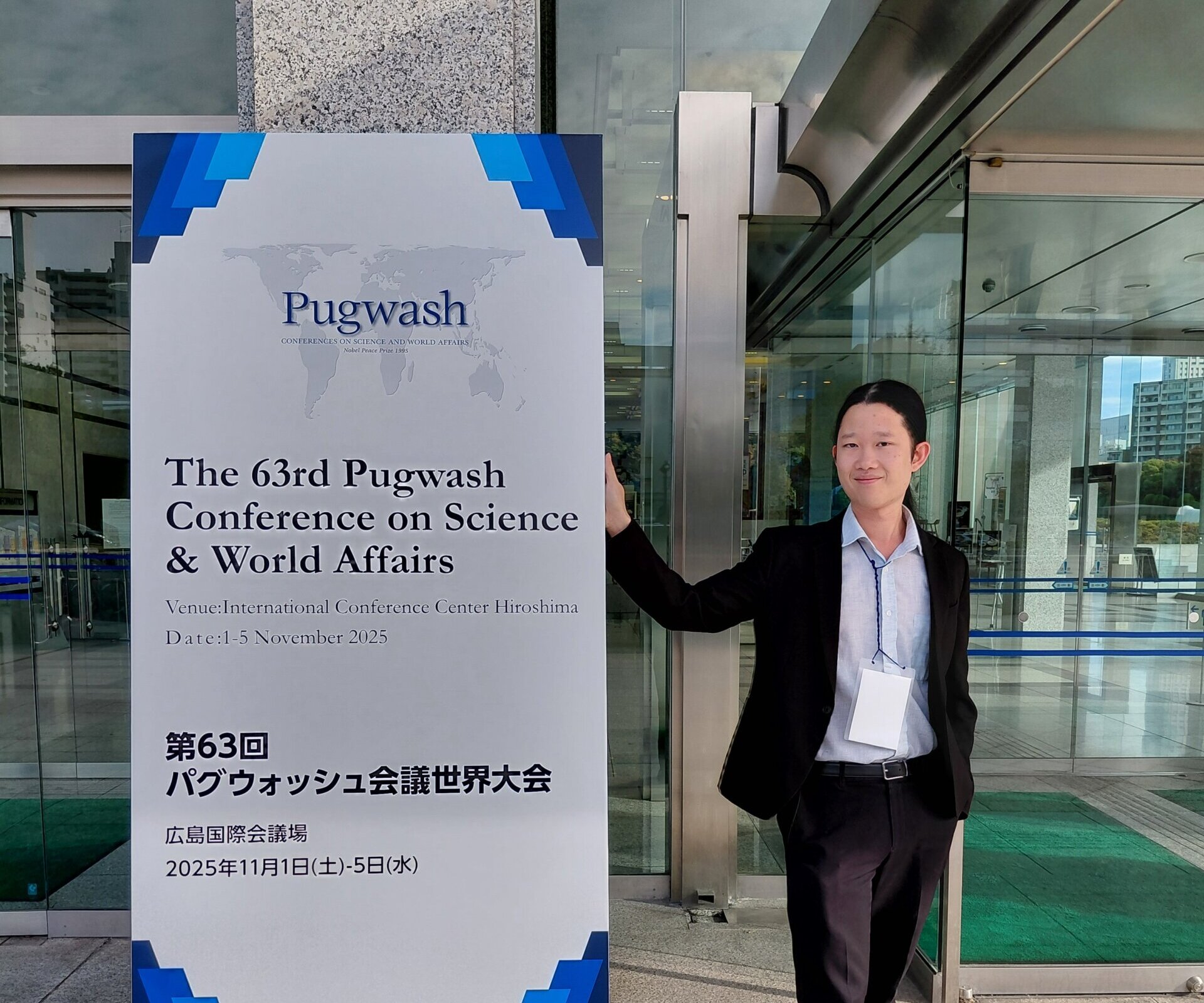
Between 1-5 November 2025, BASIC Policy Intern Ching Wei Sooi attended the 63rd Annual Pugwash Conference in Hiroshima. The title of the conference was “80 Years After the Atomic Bombings: Time for Peace, Dialogue, and Nuclear Disarmament”. As Dr. Keiko Ogura, a hibakusha and peace advocate, remarked: “Knowing is the first step to creating peace”. In an attempt to bridge geopolitical divides, the conference convened over 180 participants from 40 countries.
Ching Wei attended the Pugwash Conference to explore the links between nuclear and space issues, having presented his work on the Golden Dome’s impact on nuclear strategic stability at the Student/Young Pugwash Conference, which took place on 30-31 October. His work, co-developed with Nicolas Ayala Arboleda (Senior Consultant at Novaspace), was largely based on a series of webinars on the Golden Dome initiative hosted by Nicolas and Ching Wei under British & International Student/Young Pugwash. The webinars featured several experts, to whom the authors are extremely grateful, and whose reports can be found in the acknowledgement section of this write-up.
Ching Wei Sooi is a Policy Intern with BASIC’s Responsibilities and Global Governance Programme.
While comparisons to Reagan’s space-based missile defence “Star Wars” programme make it tempting to downgrade the importance of the Golden Dome – the United States’ new space-based missile defense initiative, or the GDA, – the early stages of this effort are already shaping the global strategic landscape. The GDA may last beyond the second Trump administration. It was raised in the webinar series that, behind closed doors, there is a rumour that Democrats are in talks with Republicans about this initiative. Therefore, the GDA’s potentially destabilising effects for strategic stability warrant close attention.
The GDA’s effects are already reverberating across capitals as nuclear-armed states attempt to make sense of what it means for their deterrence postures. The White House has released scant details about the initiative, raising the risk of misperceptions, misunderstanding, and inadvertent reactions. The US’s competitors and adversaries tend to analyse the Golden Dome through the lens of worst-case speculations, while domestic audiences (including defence companies) tend to take on an attitude of best-case optimism which risks verging on wish fulfilment.
What remains clear for now is that the GDA is best thought of as an overarching, ambitious vision for protecting the US with an effective missile defence system. The goal is to defeat not just incoming intercontinental ballistic missiles (ICBMs), but all other types of airborne threats – at any stage of flight and from any nuclear-armed state.
As for the details and how this is to be achieved, old and new systems will be integrated into a “layered, integrated, global missile defence architecture”. This layered architecture will have three core capabilities. First, detecting and tracking: terrestrial and space-based sensors will be used to detect and track missiles launched anywhere on Earth and continuously througout flight. Second, kinetic interceptors will be employed with the aim of destroying a missile during any part of its flight (space-based interceptors form a key component of the GDA, although such a capability has not yet been achieved). Third, the Golden Dome will need synchronised command and control networks that can fuse data and make split-second decisions – potentially autonomously, with minimal human input.
Private companies will be required to realise the GDA, and they are also actively shaping the form that the architecture will take. This includes both defence primes and newer entrants. For example, Lockheed Martin wants “a real on-orbit, space-based interceptor demonstration by 2028”. A different, newer start-up announced that it will invest $15 million USD to demonstrate the deployment of space-based interceptors.
There is a huge range of options for the form that the architecture will ultimately take. Key decisions remain to be taken: What kind of threats will the GDA focus on? From whom? How global in scale will the Golden Dome be? Will US bases far from the homeland need to be protected, such as those in the Indo-Pacific? Accordingly, to what extent will America’s allies and partners be involved? After all, the GDA will likely integrate data from radar stations and other sources of intelligence from across different regions in the world, necessitating a global footprint. And how many interceptors will be considered enough? Beyond development, interceptors in orbit will require maintenance, refuelling, and replacement. They will also need to be hardened against countermeasures such as lasers, electronic warfare, and cyberattacks. All of this will require substantive costs of the GDA that will need to be considered.
Todd Harrison, Senior Fellow at the American Enterprise Institute, estimates costs to be anywhere between $252 billion and $3.6 trillion – with the upper estimates resulting from a greater degree of reliance on space-based systems. As Sam Wilson, Director for Strategy and National Security for the Center for Space Policy and Strategy at The Aerospace Corporation, details, $24.4 billion has already been allocated to the Golden Dome, with large shares going to the tracking and sensing layer as well as developing space-based interceptors.
It is also important to note that comprehensive missile defence, including space-based interceptors, is unlikely to succeed. As Laura Grego, Senior Research Director of the Global Security Program at the Union of Concerned Scientists, argues in her 2017 and 2024 work on the subject, existing U.S. missile defence systems have only been tested under optimal conditions and against single missiles. In a real conflict, however, the United States could face hundreds of nuclear warheads employing countermeasures such as decoys. Moreover, space-based interceptors would themselves be vulnerable to a range of countermeasures, including anti-satellite weapons.
Nevertheless, the announcement of the GDA has unleashed downstream effects that are shaking up the strategic picture in destabilising ways, diminishing the already-dim prospects for nuclear arms control and disarmament.
Beijing and Moscow have stated that the GDA creates “hardly surmountable obstacles to the constructive consideration of nuclear arms control and nuclear disarmament initiatives”. Pessimistic branches of Russian and Chinese strategic thinking have been validated through the GDA’s pronouncement. Speakers at our Pugwash webinars shared that analysts in Moscow have long believed that the deployment of US space-based interceptors was inevitable and that analysts in Beijing worry that the US seeks to nullify its second-strike capabilities.
Therefore, the GDA raises fears from other nuclear-armed countries that the US could launch a pre-emptive first strike, relying on the Golden Dome to protect the US from the incoming second-strike of any nuclear arsenals which survived. Even if comprehensive US homeland missile defence is likely to remain imperfect, it is likely to bolster US damage limitation. Fueling such fears, speakers at our Pugwash webinars have noted the tendency for experts on all sides to demonstrate overly generous assessments of adversarial capabilities. Further, whereas US missile defence previously focused on defending the homeland from limited threats (e.g., from a small number of nuclear weapons from the Democratic People’s Republic of Korea), the GDA explicitly aims at defending the US from the huge, sophisticated salvos of nuclear peer competitors (Russia and China). As implausible as this scenario may be, militaries do plan for worst-case scenarios.
It follows that China, Russia, and other countries will react to their perceived severe security threats. It is reasonable to expect that the GDA will trigger an action-reaction arms race, qualitatively and quantitatively. Russia and China are likely to build more missiles and develop countermeasures such as novel delivery mechanisms. And the arms race sparked by the GDA would not be terrestrially confined.
The tens, hundreds, or thousands of space-based interceptors will be seen as a latent capability which could readily be repurposed as anti-satellite weapons. These could be used in a first strike to target critical space-based assets used for nuclear command and control, communications, and early warning. Space-based assets are also crucial for many modern conventional militaries. Therefore, countries that worry about American anti-satellite capabilities can be expected to accelerate the development of their own counterspace capabilities – both to hold the Golden Dome at risk and to protect their own assets in space. In the most extreme case, because a nuclear explosion in space could take out large swathes of space-based capabilities, countries may investigate the possibility of detonating a nuclear weapon in space to counter the GDA. In this context, the US allegation that Russia is developing a nuclear anti-satellite weapon takes on a different light.
The outstanding question therefore remains: what is to be done to mitigate the potential destabilising effects of the GDA?
First, technical scientific studies of the real capabilities of missile defence must feed back into national policy. In general, more research is needed on the different configurations that the Golden Dome could take and the corresponding risks that different shapes entail.
Second, pre-launch notification of space launches should be strengthened. In this context, the pre-launch notifications of the Hague Code of Conduct should be consistently adhered to and universalised, including through working with commercial space companies. If even a limited number of kinetic interceptors were deployed in space for boost-phase intercept, the short response time means that they may need to be launched immediately upon detecting a plausible enemy threat. Notifications will help to avoid the accidental interception of space launch vehicles or missile tests.
Third, states should continue to endeavour to work on legally binding instruments and norms of responsible behaviour in space rather than accepting weapons and war in space as a fait accompli. Both approaches should be recognised as complementary and their complementarity should be operationalised: for instance, by enshrining political moratoriums on destructive direct-ascent anti-satellite missile-testing into domestic legislation.
Moreover, further dialogue and research could begin at the track two level to substantially engage with topics such as verification, transparency, and confidence-building, which have been identified as key priorities in existing PAROS documents – e.g., from the consensus Final Report of the 2024 Group of Governmental Experts and the Chairperson’s summary of the 2022-23 Open-Ended Working Group. Track one-and-a-half and two dialogues – such as BASIC’s Responsibilities and Global Governance dialogues – could provide opportunities for constructive and emphatic dialogue on these topics, including on aligning threat perceptions in space. It is likely that Russia, China, and the United States are operating with a combination of “peaceful/defensive self-images” (with each country believing that their adversaries recognise that they do not harbour malign intent in the acquisition of new systems) and “enemy images” (viewing the other country as inherently hostile, untrustworthy, and aggressive). Pathways to alleviate the orbital security dilemma could be explored by unpacking these dynamics.
Moreover, states developing counterspace capabilities should explain how their behaviours align with the principles of the Outer Space Treaty, the goals of preventing an arms race in outer space, and existing multilateral initiatives to preserve peace in orbit. In this respect, more transparency from the US on the rationale behind the Golden Dome and its specific objectives, including how it relates to responsible space behaviours, would improve the quality of discussion and potentially assuage worst-case fears and concerns.
Finally, a sustained international community of practice focusing on the nuclear-space nexus should be fostered. More research is needed on the impact of contemporary developments in space on strategic stability and nuclear deterrence. Research on the converging impacts of different domains and technologies on strategic stability should also be fostered, such as how the cyber-space nexus, which is increasingly integrated with AI, could spark conflict and create novel nuclear risks.
Acknowledgments
The author would like to thank Dr. Laura Grego, Todd Harrison, Dmitry Stefanovich, Dr. Cameron Tracy, Dr. Jesica West, Robert “Sam” Wilson, and Dr. Tong Zhao for readily sharing their valuable knowledge and being open to participating in the event series.
A selection of their write-ups relevant to the GDA include:
- Grego, L. 2025. Do technology advances allow missile defences to make up ground? Journal of Strategic Studies 48(2):465-509. https://www.tandfonline.com/doi/abs/10.1080/01402390.2024.2447306.
- Harrison, T. 2025. Build Your Own Golden Dome: A Framework for Understanding Costs, Choices, and Trade-offs. AEI. https://www.aei.org/research-products/working-paper/build-your-own-golden-dome-a-framework-for-understanding-costs-choices-and-tradeoffs/.
- Tracy, C.L. 2021. Slowing the Hypersonic Arms Race: a Rational Approach to an Emerging Missile Technology. Union of Concerned Scientists. https://www.ucs.org/sites/default/files/2021-04/slowing-the-hypersonic-arms-race.pdf.
- West, J. & Barrett, K., 2025. Golden Dome Explained: Ambition, Reality, Risk. Project Ploughshares. https://ploughshares.ca/golden-dome-explained-ambition-reality-risk/.
- Wilson, R.S. 2025. FY 2026 Defense Space Budget: Emergence of Golden Dome. The Aerospace Corporation: Center for Space Policy and Strategy. https://csps.aerospace.org/papers/fy-2026-defense-space-budget-emergence-golden-dome.
- Zhao, T. & Stefanovich, D. 2023. Missile Defense and the Strategic Relationship among the United States, Russia, and China. https://www.amacad.org/publication/missile-defense-and-strategic-relationship-among-united-states-russia-and-china.