
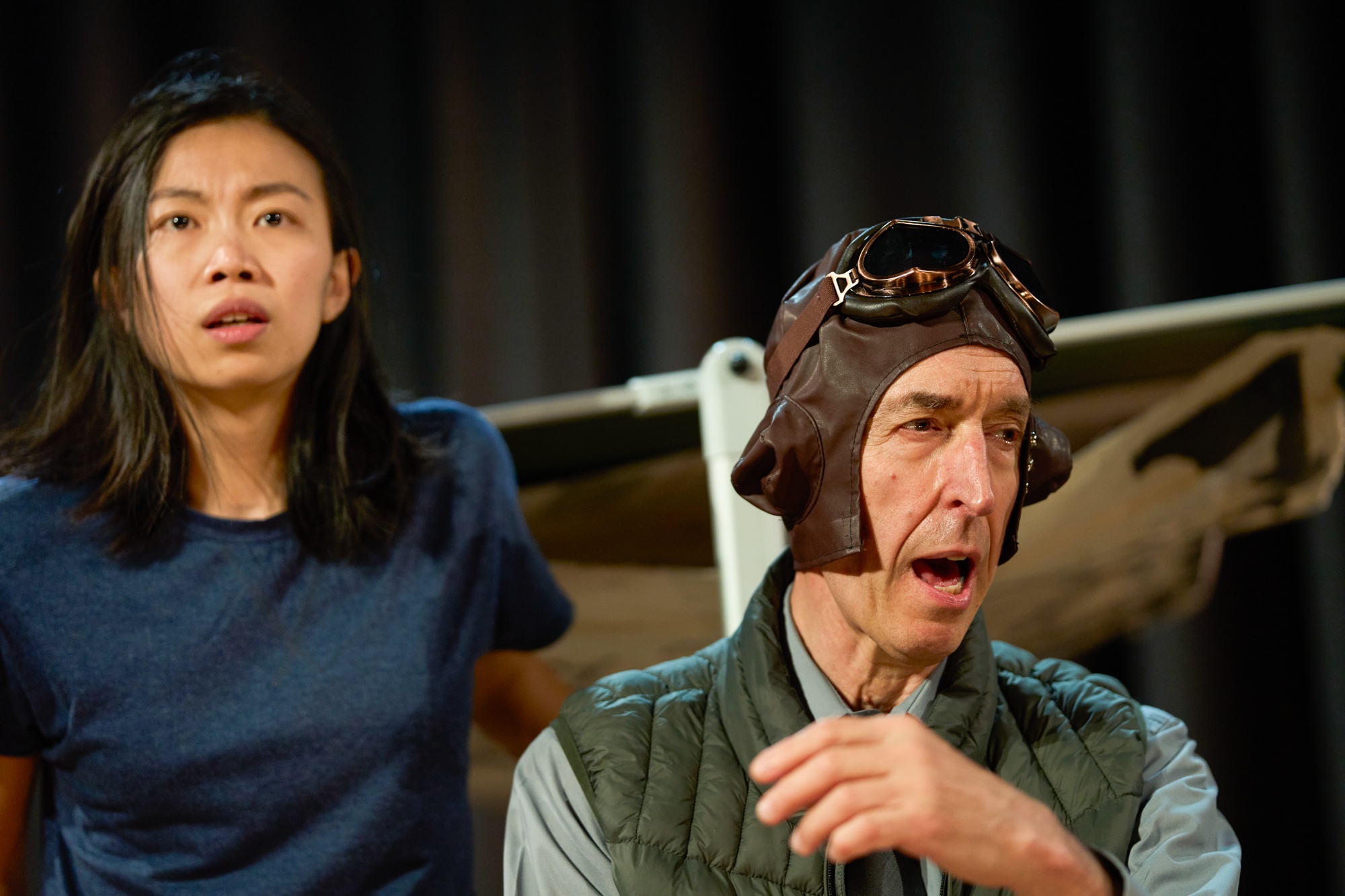
The Mistake, an award-winning play by Michael Mears about the atomic bombing of Hiroshima and the events leading up to its development, toured four US states in April and May of this 80th anniversary year followed by a three week run off-Broadway in New York – while the latest discussions on the Nuclear Non-Proliferation Treaty were taking place at the United Nations. It also toured Japan in September, including a performance in Hiroshima, before playing for a final week in London in October. Here Michael Mears responds to questions on what inspired him to write drama about nuclear weapons and what his plans are for the future.
Michael, how did you come up with the inspiration to write The Mistake?
“Last year, at Friends House in Central London, I had an encounter that profoundly influenced my life. It was the first time I got to meet an actual atomic bomb survivor, rather than just reading their accounts or hearing their testimonies in documentaries. Toshiko Tanaka is a gentle and inspiring woman, 86 years old, who was six when the atomic bomb was dropped on Hiroshima. She was one of the few in her family who survived. Many of her school friends died. Toshiko suffered burns and injuries and has had lifelong health issues. Yet despite the hardships she still has a cheerful countenance and positive outlook. Hearing her story and witnessing the way she answered questions, I was struck by her modesty and humility.
“But at the same time, travelling the world to speak out against nuclear weapons, she passionately argues that those bombs should never have been dropped, and should never, ever be dropped again. In short, Toshiko was an inspiration to me and meeting her convinced me that I needed to redouble my efforts as a playwright to tell the world about what happened in Hiroshima and Nagasaki. Because Toshiko’s message is one that we must never forget.”
What research did you take prior to writing the play?
“I realised there was a gap in the market. The film Oppenheimer (2023) is admirable in many ways. But one of the main criticisms of the film is that it doesn’t reference the Japanese experience at all. I started working on my play slowly − on and off − over many years, long before the film. But I was always adamant that my play would reflect the Japanese experience, which is why it was so important for me to have a Japanese survivor as a central character in it. This would be a way in which I could share some of the accounts of the survivors.
“But I wasn’t sure how I was going to make the play work. I had a lot to consider. While I knew that I wanted to focus on a survivor, I also had to devise a plot. My original idea for the play began after I read a newspaper article in The Guardian 22 years ago, on Hiroshima day, August 6th – an article (now yellowing) that I still have. It was an in-depth interview with Paul Tibbets, the pilot of the B-29 bomber the Enola Gay, with a photograph of him holding a model of the plane at the time. On the opposite page was an interview with Fumiko Miura, a survivor of the Nagasaki bombing, who became a poet. It was these two interviews from 22 years ago that inspired me in much the same way as Toshiko Tanaka did.
“Clearly the two people interviewed in The Guardian had never met. And clearly the pilot had never returned to Hiroshima, and had never met any hibakusha – atomic-bomb survivors. So, I thought, how about writing a play where the pilot actually gets to meet a survivor, or a descendant of a survivor, and difficult questions are asked? That’s where I started from. It was only later that I began to consider the science, to think about the people who created the bomb.”
Explain the importance of Leo Szilard and Paul Tibbets in the Hiroshima story
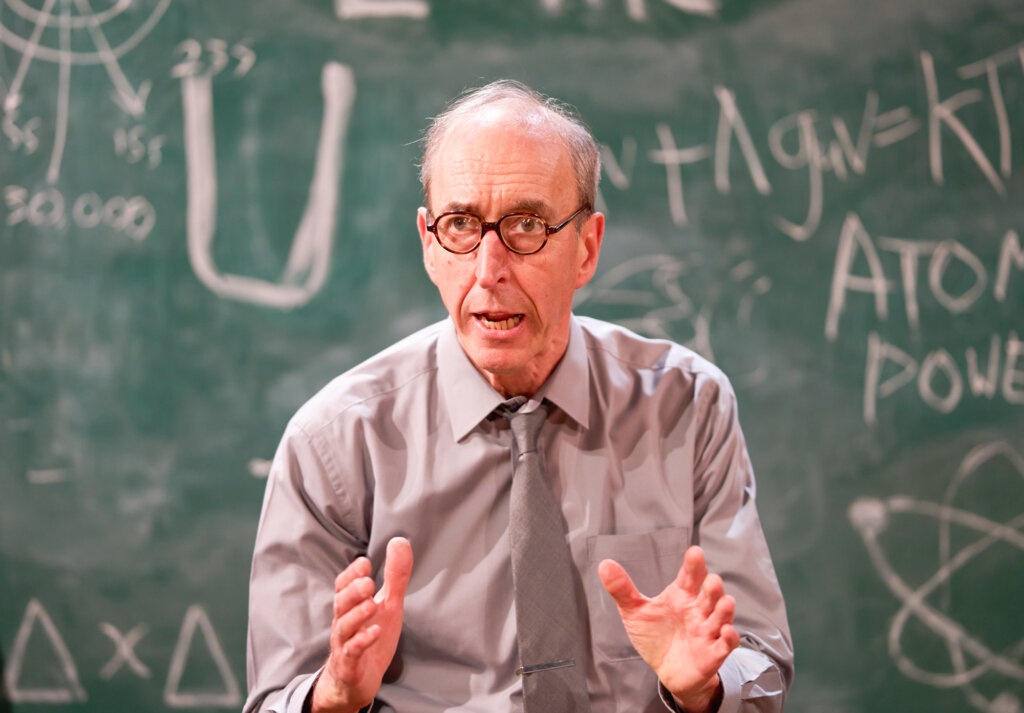
“While a lot is known about Robert Oppenheimer, less is known publicly about a very important scientist on the Manhattan Project called Leo Szilard. He was a Hungarian Jew and a brilliant nuclear physicist, who had studied with Einstein and then became lifelong friends with him. Szilard really interested me because he seemed to feel terribly guilty about his role in creating the bomb. Initially he and many other European refugee scientists came to America to work on the Manhattan Project with the intention of building the bomb before Hitler did. They did not foresee that their creation of mass destruction might be used for other purposes after the demise of the dictator.
“When Nazi Germany was defeated, Leo Szilard was horrified to learn that the bomb was now going to be used on Japan. He had a complete change of heart and did all he could to prevent the bomb from being used. He was up against the US government and the US military and this was in the middle of a war. Yet he worked ceaselessly to persuade the powers that be to delay using the bomb − or at least use it on neutral territory and not on Japanese cities. Of course, he didn’t succeed.
Excerpt from The Mistake by Michael Mears
General Tibbets, who was the pilot who flew the plane which dropped the atomic bomb on Hiroshima, is being challenged by a young Japanese woman during a talk he’s giving about his latest book…
GENERAL TIBBETS There was a shortlist of four cities: Hiroshima, Kokura, Niigata and Nagasaki. Up till then, they’d all been spared.
WOMAN Spared?
GENERAL TIBBETS (To his audience) It was important they had not been previously damaged because the scientists wanted to analyse all the effects of an atom bomb being dropped on a city.
WOMAN So it was really an experiment? Requiring the deaths of one hundred thousand-
GENERAL TIBBETS (To his audience) The war needed to be ended. Though we’d destroyed many Japanese cities, what we had not been able to destroy was their will – their will to carry on fighting regardless.
WOMAN But we were ready to surrender!
GENERAL TIBBETS (To his audience) What was the question over there?
WOMAN (Standing up) Did you ever find out, General Tibbets?
GENERAL TIBBETS You’ve had your turn.
WOMAN Exactly how those 100,000 people died?
GENERAL TIBBETS I knew what we had prevented-
WOMAN The unspeakable agonies they suffered?
GENERAL TIBBETS — How many would have died, at least 500,000 American and Japanese soldiers, if that bomb hadn’t been dropped and we’d had to invade instead.
WOMAN (Reading from a diary) ‘So many schoolchildren who’d been working out in the open are now lying dead.’
GENERAL TIBBETS What in God’s name were they working out in the open for?
WOMAN (Reading) ‘All they’d been doing was to help tear down houses to create fire-breaks.’
GENERAL TIBBETS Big mistake! The children should have been evacuated. What were the Japanese authorities thinking?
WOMAN Do you have no regrets about innocent children dying such terrible —
GENERAL TIBBETS Lookit, there’s never been a damn war fought anywhere in the world where innocent people didn’t get killed or maimed. That’s just their tough luck for being there.
WOMAN Tough luck?
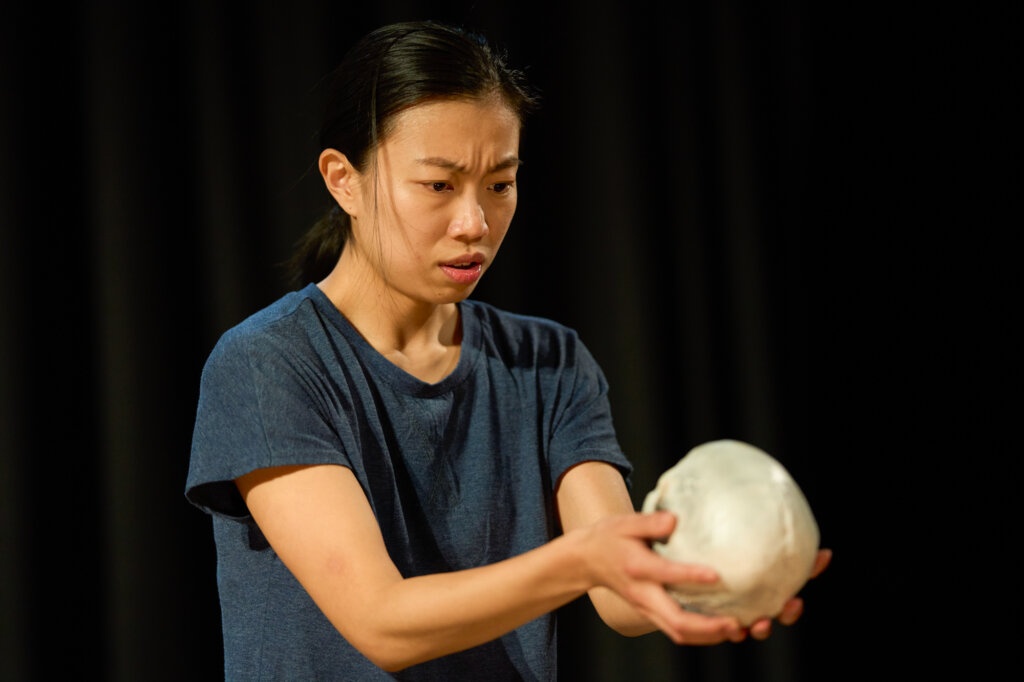
“I became fascinated by Szilard and realised that somehow he had to be in my play. Hence my production evolved into a work concentrating predominantly around him and two other people: a young female survivor in Hiroshima searching the devastated city for her parents; and the pilot Paul Tibbets, as an elderly man, who had never shown any remorse. I wanted to focus on this question: how was it possible for Tibbets to cut off his emotions like this? We know that part of military training requires servicemen to cut off their emotions, not to view the enemy as human beings who are exactly the same as them. If the airmen had any kind of sympathy or empathy for the people they were bombing, they wouldn’t be able to carry out their deadly mission.
“Yet this still does not fully answer why Paul Tibbets did not feel any remorse or regret. So, I tried to address this in the play through the character of a modern Japanese woman who puts some very challenging questions to the pilot when he’s an old man on a lecture tour promoting his book.
“As for Leo Szilard, I wanted to explore what drives scientists to explore, experiment and make new discoveries − sometimes without truly considering the consequences. Szilard definitely had some sort of dark foreboding that he was working in a dangerous area and was tampering with the powers of nature; knowing that once you unlock those powers, you’ll never be able to put them ‘back in the bottle’ again.
“I found Szilard’s whole journey to be fascinating. He was initially very excited about creating the nuclear chain reaction, unlocking atomic power, and all the positive benefits that derived from it − including the creation of a bomb capable of stopping Hitler in his tracks. How did he go from there to thinking that we should never, ever use this bomb because it cannot be morally justified? After the two bombs were dropped on Japan, he spent much of the rest of his life working to secure stronger international arms controls. He was in effect trying to control the monster he’d helped to create.”
How much of The Mistake is fact and how much fiction?
“While there’s a lot of verbatim dialogue in the play, there’s also a lot of imagined dialogue. For example, when Szilard went to see President Truman to persuade him not to use the bomb, Truman in response sends him to his Secretary of State. We know that Leo Szilard subsequently met the Secretary of State and urged him not to use the bomb − or at least to drop it in an unpopulated area − but we don’t know exactly what was said. However we do know what their opinions were, enabling me to create an imaginary dialogue between them in the play.
“The central character in the play, Shigeko, is played by a remarkable young Japanese performer, Riko Nakazono. Everything that happens to her in the play happened to different survivors; I put her character role together from different survivor accounts.
“For research into Leo Szilard, there’s an excellent biography about him, by William Lanouette, and there are interviews and documentaries about him on YouTube. The same is true of Paul Tibbets, who also wrote a book. So, I was able to write my play using various different sources as well as my imagination.”
“The play is performed with just two actors – one Western (myself) and one Japanese. I enact all the Western characters, including the scientists, politicians, and military, as well as brief cameos as President Roosevelt and even Albert Einstein! Riko Nakazono plays Shigeko in 1945 as well as the modern Japanese woman looking for answers from the pilot as to why that bomb had to be dropped.”
What’s the message behind the play?
“I view it ultimately, as an act of healing and reconciliation. It’s an attempt to understand why terrible things happen through individual stories and experiences − particularly in the case of Riko’s character, Shigeko. In the course of my research, I came across this great three-word quote: “Statistics don’t bleed.” I’m not sure who said it, and of course statistics about war are very important. They demonstrate how many people died, how many people were injured, and so on. So when we talk about Hiroshima and Nagasaki, the statistics are important – and yet it’s hard to take in what 100,000 or 70,000 deaths really means.
“But, if you follow an individual story through a play, their journey, what happens to them, the things they witness while desperately searching for their family, that has a much more powerful and emotional effect. So, I really hope the play has opened hearts and minds.”
What has been the reaction to your play?
“I was quite nervous about taking it to the USA. But a lot of our audiences were very sympathetic. Performing it in Japan in September 2025 was a very different experience − especially when we appeared before an invited audience in Hiroshima that included three elderly atomic-bomb survivors. Again, we were unsure how Japanese audiences would react to the harrowing subject matter, so much a part of their recent history. But the overwhelming response was one of profound gratitude that a Western artist had such an affinity with these stories and had taken the time and trouble to reflect the experiences of all sides in relation to these terrifying events. It was humbling that our small theatre company had come all the way from London to share the play with them.”
Are you optimistic that a future nuclear catastrophe can be averted?
“In January 2025, atomic scientists moved the Doomsday Clock even closer to midnight, by one second. It’s currently 89 seconds to midnight. The world is in such a fragile state now. So, the play is not simply history. The Mistake feels ever more relevant and urgent now. We want to keep making people aware and remind them of the terrible consequences of using these weapons. It’s clear that we face formidable challenges. It was extraordinary to me that some pupils of UK schools where we performed − and even some adults − knew very little about Hiroshima and Nagasaki. So, there’s a lot of sense in what Toshiko Tanaka is doing, travelling the world, advocating for peace: we must not forget.”
What are your plans for the future?
“Such was the positive response to the play in the US, UK and Japan that we want to arrange more performances in 2027. We would like to travel to Japan more extensively – having played in Tokyo this year we are now keen to go to Nagasaki and the north of the country, as well as returning to Hiroshima for more performances. We would also like to return to Chicago (where the initial chain reaction experiment took place) for a longer run and take the play to the West Coast and New Mexico − where the initial atomic bomb test took place in July 1945. There are numerous cities and towns in the UK we still haven’t reached.
“Ideally, I would like to perform the play in all nine nuclear-armed countries. It should be possible in India, but taking it to Russia and North Korea seems less likely. But if it’s possible to split the atom, such an outcome cannot be completely ruled out.”
Michael Mears is a British actor who has worked for over four decades in theatre, television and film – including seasons with the National Theatre, the Royal Shakespeare Company and the Peter Hall Company, portraying many classical and Shakespearean roles. He has worked in London’s West End (including in the long-running The Woman In Black) and in many of the UK’s regional theatres. He is perhaps best known as an award-winning performer of his own original solo plays for theatre and radio, including This Evil Thing, his play about Britain’s WW1 conscientious objectors, and most recently The Mistake, his play about Hiroshima – performed by himself and a young female Japanese actor.
The Mistake opened at the Edinburgh Fringe in 2022, toured the UK in 2023, and played in the USA and Japan in 2025, the 80th anniversary of the atomic bombings of Hiroshima and Nagasaki. www.michaelmears.org