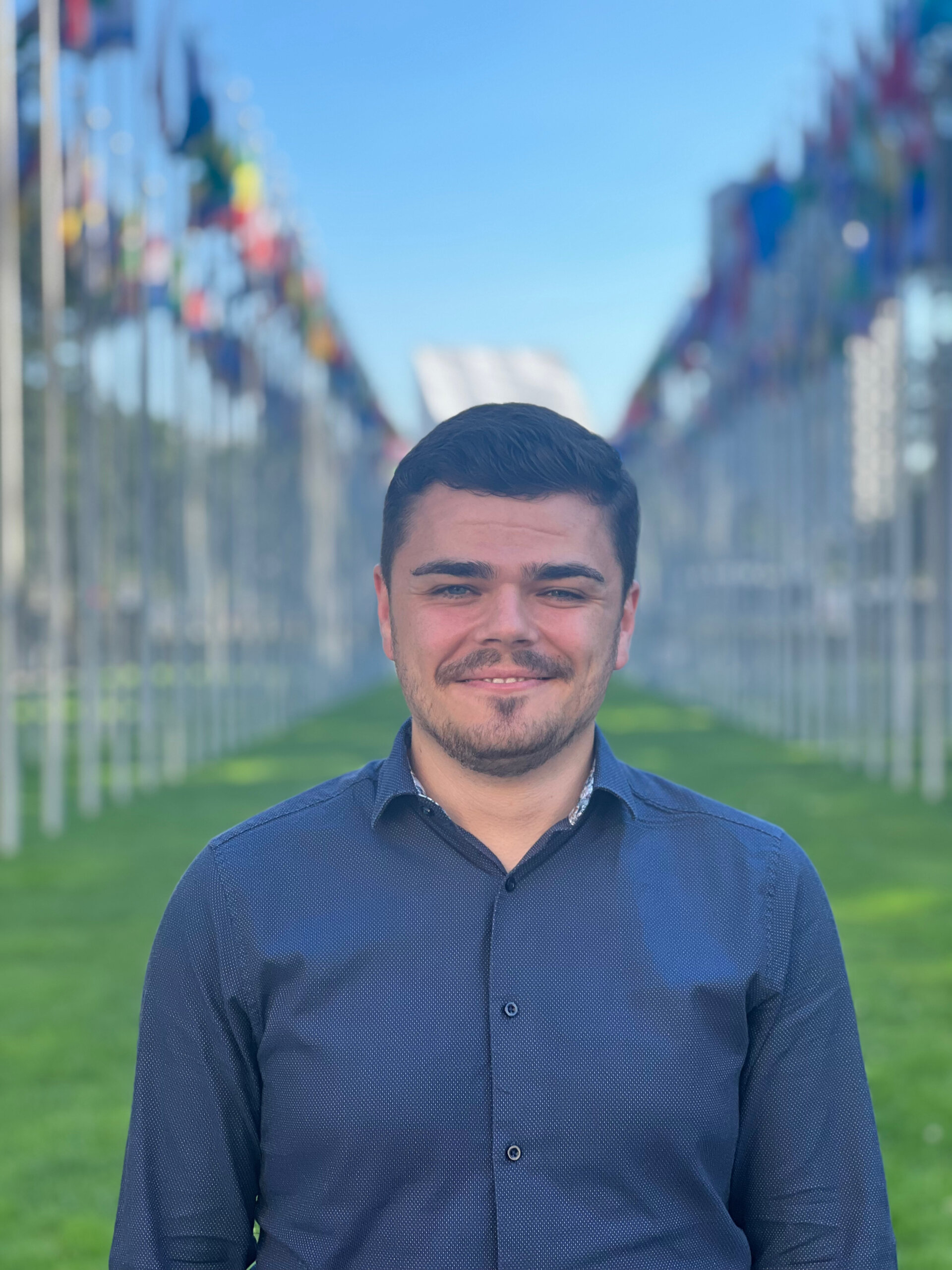
Envisioning the Future of Nuclear Security is the latest report of BASIC’s Emerging Voices Network (EVN). It has been made possible thanks to a grant awarded to Policy Fellow Declan Penrose as part of his Horizon 2045 Nuclear Futures Fellowship, a joint initiative between the Ploughshares Fund and Horizon 2045.
“The aim is to train early to mid-career in the nuclear field in what is known as foresight methodology – the prediction of multiple potential future outcomes at the same time so that the worst case and best case scenarios in terms of nuclear security are accounted for,” Declan said.
The fellowship is awarded to a small group of young leaders who want to build the adaptive leadership practices, tools, and relationships necessary to help enhance nuclear security in a constantly changing environment. The fellowship provides an opportunity to learn new skills, including a grant to conduct a “Capstone Project”, enabling participants to implement foresight methodologies developed during the course of their fellowship.
For his Capstone Project, Declan wanted to instigate collaborative research with the EVN network while reaching out to other specialist early-career networks that work across various security domains. This included climate, bio, and finance experts, to name a few. He developed an ambitious two-phase project that included several tools to envisage the future of nuclear security.
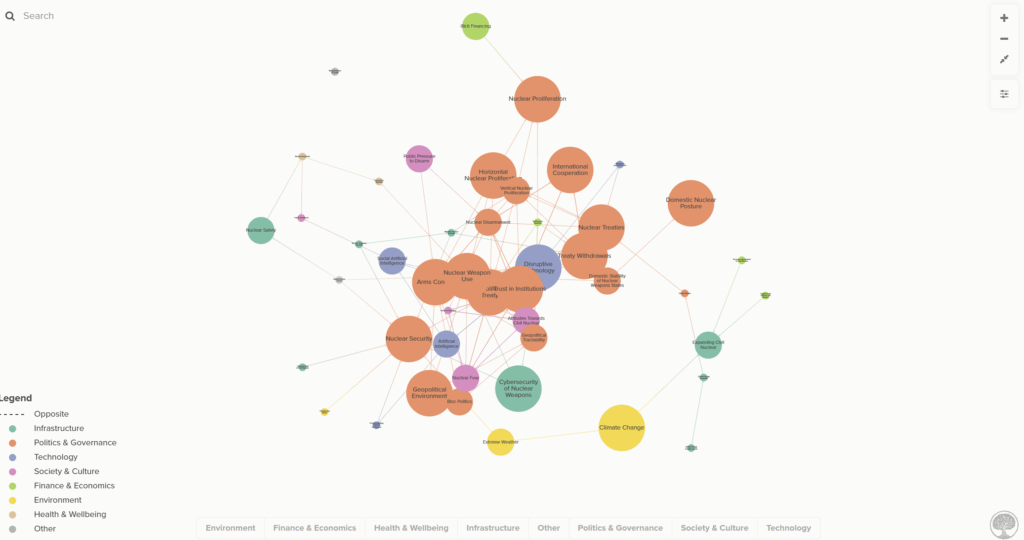 The answers provided by young security experts was converted into a systems map using the Kumu programme
Phase One of the project involved the creation of a systems map that visualises the key drivers of future nuclear security, as seen by the next generation of security experts. They were provided with a “scanning form” − circulated to many early career security networks − that asked them what are the things which they believed are the most important in terms of shaping the future of nuclear security in seven domains. They were then asked to name which drivers they deemed to be most important and why they are so significant. Their answers were converted into a systems map using the Kumu programme, compiled with expert guidance from consultant Chris Spedding, founder of Loop Works.
Phase Two of the project brought 11 of experts who had completed the scanning form into four focus groups. They then participated in a “scenario exercise” where they used drivers from the Kumu map to help envisage four possible outcomes for nuclear security. (All the drivers and their definitions are listed in the appendix of this report). The scenario exercise was an intensive three-hour workshop that utilised foresight tools and methodologies. Both Phase One and Phase Two are included in the final report.
The Emerging Voices Network (EVN) is a sustainable global network of high potential, early career technical and policy experts who have begun to inherit the responsibility to manage nuclear threats.
Read the report below: