In this article, Dr Manuel Herrera Almela, Senior Policy Fellow at BASIC and Manager of the Non-Proliferation and Disarmament Programme, reflects on the signing of the memorandum of understanding (MoU) between Iran and the United States. The views expressed belong solely to the author of the article and do not necessarily reflect their government’s position, any affiliated institutions, or that of BASIC.
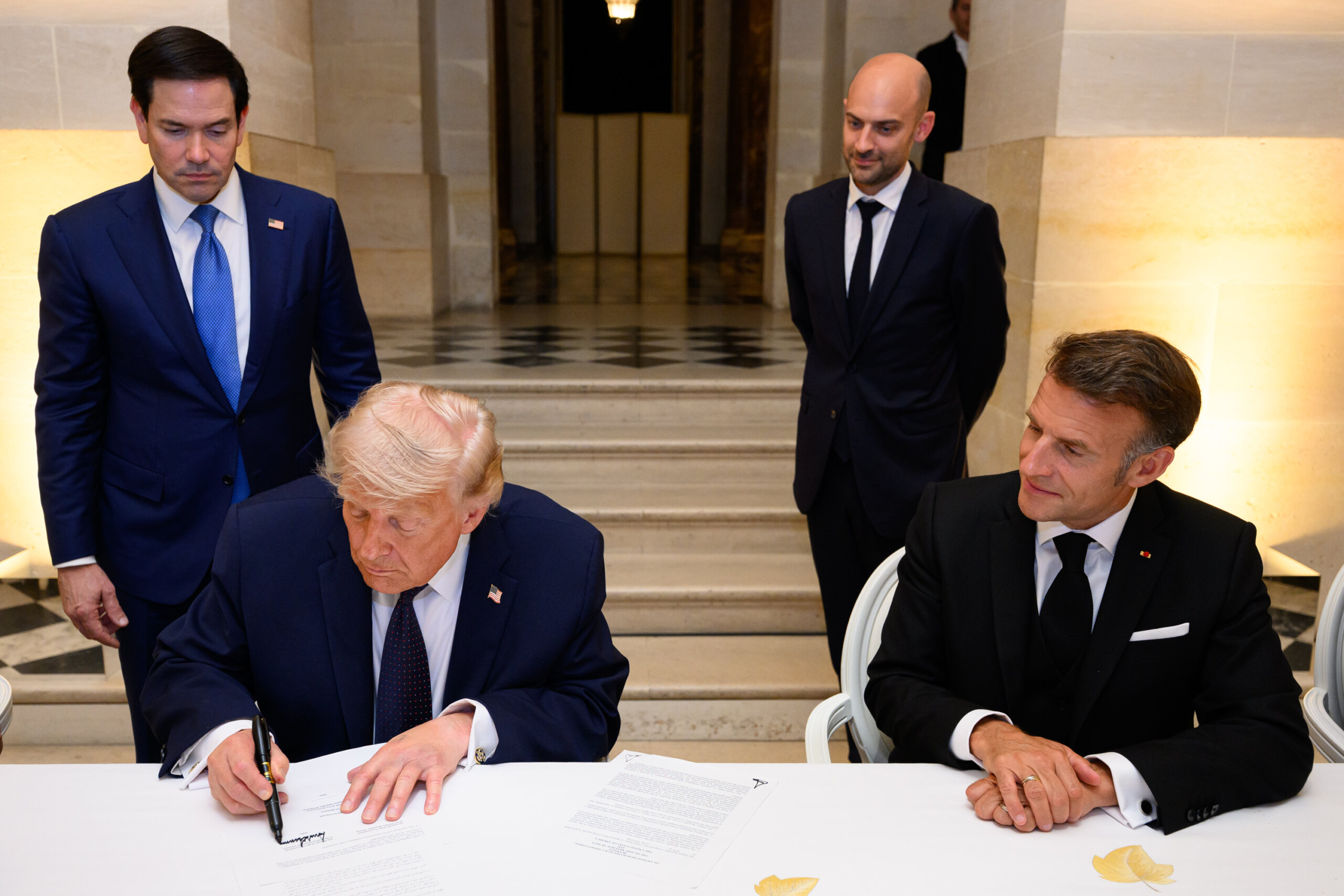
When he laid down his pen at the Palace of Versailles in France on 17 June, US President Trump had not only agreed to end a war. His signature also marked a major break with US policy on Iran after almost 50 years of sanctions, sabre-rattling, “shadow war”, and, since 2025, direct attacks on the country.
The 14-point MoU between Iran and the United States, signed at a G7 Summit dinner hosted by President Macron of France, commits the two countries to negotiate a “final deal” within 60 days. Beginning by declaring “the immediate and permanent termination of military operations on all fronts”, the MoU rattles through points on territorial sovereignty, the naval blockade, the Strait of Hormuz, and reconstruction, before finally arriving at sanctions, nuclear weapons, and the unfreezing of assets. Here, the United States strikes out into territory unexplored by US administrations for decades: the ending of all sanctions on Iran, and the acceptance of the “status quo of [Iran’s] nuclear program”.
A Call for Clarity
For nuclear experts, there are serious questions hanging over this “deal” and the conspicuously vague MoU that precedes it. Three issues are particularly critical, both to Iran’s nuclear future and to the global community’s ability to monitor Iranian compliance with nuclear safeguards.
Firstly, President Trump has broken with his own long-held position (spanning both presidential terms) on Iranian nuclear activity, by accepting that Iran will continue to have uranium enrichment capabilities. This is a major shift in policy. Previously, like most US presidents before him, President Trump had argued that Iran should not be allowed to enrich uranium, whether for producing energy or weapons. It was only with the signing of the 2015 Joint Comprehensive Plan of Action (JCPOA) – an agreement between Iran, the P5+1 (the UN Security Council plus Germany), and the European Union – that the US, then led by President Obama, had changed its position, accepting that Iran could preserve its enrichment capacity under strict conditions. When President Trump announced the United States’ withdrawal from JCPOA in May 2018 and reimposed strict sanctions on Iran, it was back to business as normal.
That era is now over. The United States appears to have decided that an Iran with uranium enrichment capabilities is unavoidable. Although the MoU “reaffirms” that Iran “shall not procure or develop a nuclear weapon”, there is scant reference to Iran’s stockpiles of enriched uranium, which far exceed the levels needed for producing nuclear energy. Like so much else, these details are deferred until the “final deal”. And there is no reference to one of the most pressing questions of all: the future of the centrifuges that enable Iran to enrich uranium in the first place. This is crucial. Iran’s nuclear programme hinges not so much on quantities of enriched uranium but on the capacity to create it at all.
Clarity is urgently needed here. There must be pressure on all parties to push Iran to grant access to the International Atomic Energy Agency (IAEA) to carry out inspections of Iranian nuclear stockpiles and facilities – a move blocked by Iran since 2022. The MoU avoids mentioning a timeframe for inspections, leaving Iran room for manoeuvre: since the MoU was signed, there have been mixed messages from the IAEA and both the US and Iranian governments about when inspections will take place. It is unclear whether negotiators will be able to agree an inspection protocol within 60 days or whether the United States will request inspections of facilities not covered by Iran’s 1974 Comprehensive Safeguards Agreement (CSA). Only by pushing for such inspections to go ahead in accordance with CSA terms can the international community confirm whether or not Iran is complying with its obligations.
60 Days and Counting
The second major issue is time: 60 days is simply not enough to negotiate a final technical agreement for Iran’s nuclear programme. The selection of such a brief time period likely stems from skilful diplomacy by Iran’s delegates, who realise that it will take far longer to negotiate the complex minutiae of its future nuclear programme. The unspoken reality here is that by kicking so many of the details about stockpiles, enrichment capabilities, and inspections down the road, Iran will force the US into agreeing to extend the 60-day period. If this happens – as seems inevitable – it will give Iran more time that it could potentially use to expand its enrichment capabilities and stockpiles and create new nuclear sites, while buying itself leverage with the US that it could use to strike a stronger final deal.
Feeding into this dynamic, the lack of nuclear expertise within the US delegation is the third issue that could spell trouble for the agreement. This concern isn’t new: Iran expressed frustration back in February, during talks in Geneva, about the US team’s negligible nuclear knowledge and diplomatic experience, intimating that it indicated the United States was not taking the negotiations seriously enough. With the new MoU marking a radical shift from US geopolitical orthodoxy on Iran, and the 60-day finalisation period emerging as a sharp strategic play, Iran’s negotiation skills and knowledge seem to have trumped the Americans, for now at least.
A New Era for Iran/US diplomacy?
The action on sanctions lends further credence to this idea. The US agreement “to terminate all types of sanctions” against Iran, including UN Security Council sanctions, marks the first time since the Iranian Revolution in 1979 that there will be no US or UN sanctions against the country. With the ending of sanctions, Iran is effectively repositioned as a normal, recognised state within the international community. This is a major victory for Iran. Just four months ago, when the US and Israel launched their attacks on the country, the talk was of regime change, Iran’s pariah status, and a total block on the country having uranium enrichment capabilities. Today, things look very different.
Time will tell whether negotiators on both sides can steer the talks towards a final agreement without things being derailed. The stakes are high: without progress, there is a risk of further conflict – a picture complicated by Israel’s frustration at the war’s failure to bring down the Iranian regime, and by the influence of the US mid-term elections in November on President Trump’s foreign policy. Civil society needs to keep a watchful eye and to keep up momentum on the need for inspections and for dialogue, transparency, and monitoring: in an increasingly volatile international “order”, cautious optimism must go hand in hand with pragmatic realism about the transnational challenges facing global security.